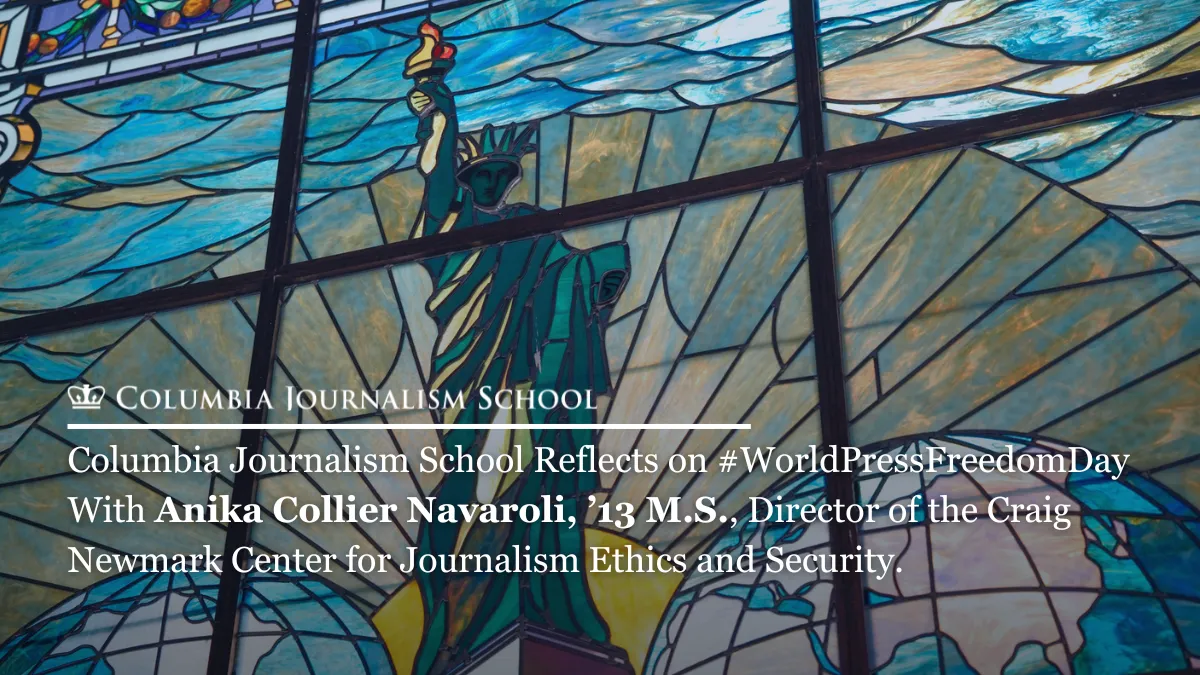
The conditions under which journalists work are rapidly changing, shaped by evolving technologies, increasing security risks and declining public trust. At the same time, the role of a free press has never been more critical.
This year’s World Press Freedom Day theme, "Shaping a Future at Peace: Promoting Press Freedom for Human Rights, Development, and Security," shares that urgency, highlighting how press freedom supports human rights, development and global security. To mark the occasion, Anika Collier Navaroli, ‘13 M.S., director of the Craig Newmark Center for Journalism Ethics and Security at Columbia Journalism School, reflects on the challenges facing journalists today and how the next generation can be equipped to navigate them.
This year’s World Press Freedom Day theme connects press freedom to human rights, development and security. Why is that connection so important right now?
A free press is essential to protecting human rights and strengthening democratic systems. At its core, press freedom is rooted in freedom of expression, a fundamental human right that enables individuals and communities to share information, hold power to account and participate fully in society.
At a moment when journalists face increasing threats around the world, strengthening press freedom means investing in ethical, secure journalism and technology that can withstand those pressures and continue to serve the public.
How does the Craig Newmark Center for Journalism Ethics and Security approach journalist safety, security and ethics?
At the Newmark Center, we focus on the risks journalists are facing in what has become an increasingly hostile environment for press freedom. Our goal is to help equip today’s journalists with the tools they need to navigate those risks safely.
We do that through trainings, events and practical resources that emphasize both physical and digital security, alongside ethical decision making. We want journalists to be prepared to report responsibly in complex, high-risk environments while maintaining the highest standards of the profession.
What role do journalism schools play in shaping a more secure and ethical future for the press?
Journalism schools play a critical role in preparing students not just to report, but to make thoughtful, ethical decisions in a rapidly changing media landscape.
At Columbia, that starts with core ethics training that all students take, which the Newmark Center helps shape. I also teach a course focused on ethical decision-making and policy creation in the tech world, where students grapple with the real challenges shaping journalism today.
Just as importantly, we integrate digital and physical security into hands-on reporting experiences, so students leave not only with strong reporting skills but with the awareness and tools to navigate the realities of the field.
What gives you hope about the future of press freedom?
What gives me hope is the next generation of journalists.
As an alum, it’s incredibly meaningful to be back teaching in the same classrooms where I once sat. Hearing how committed today’s students are to truth, accountability and the fight for press freedom gives me real optimism about where the field is headed.
Learn more about the Newmark Center and Columbia Journalism School’s work to safeguard press freedom.