Visual Identity Guide
Every interaction tells our story. See the brand guidelines below for colors, logos, typography and more.
Reporting begins here.
The Columbia Journalism School brand encapsulates our story and communicates our mission and values. Our Brand Style Guide outlines the visual identity of the school and offers a unified voice for telling our story. As one of our most valuable assets, our brand should be represented plainly and consistently.
Our brand architecture fits within the visual identity of Columbia University. Columbia Journalism School trademarks are provided exclusively through the school’s Communications Department.
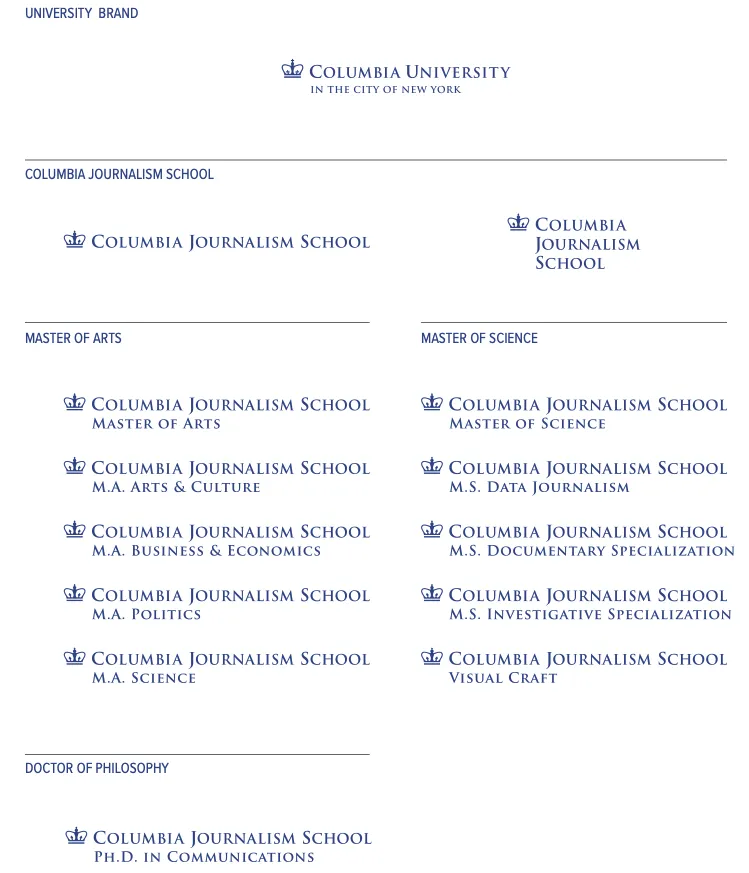
The Columbia Journalism School trademark aligns with University standards. Columbia Journalism trademarks should only be used for official University business. Please reach out to the Communications Department with any questions. The Columbia Journalism School trademark was designed using the official typeface, Trajan Pro, with a precise size, weight and kerning between letterforms. Do not try to recreate the trademark. If you need a specific mark created, please reach out to the Communications Department.
Trademark Restrictions
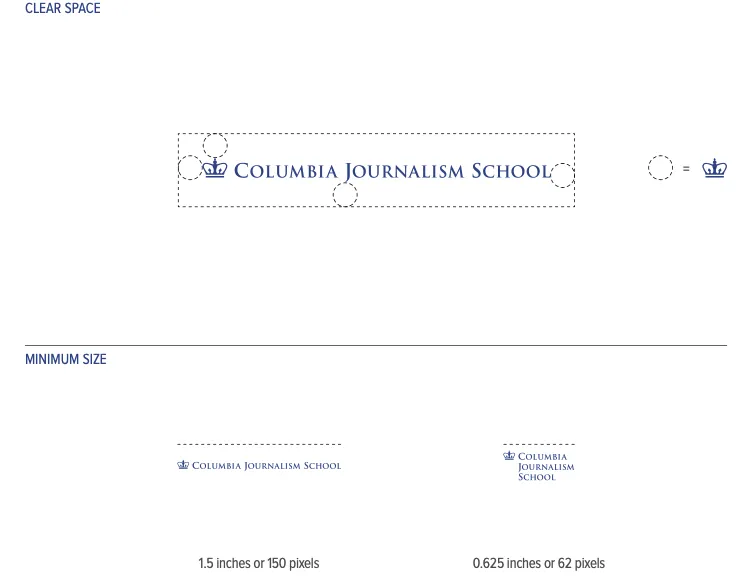
The Columbia Journalism trademark must be large enough to be legible. In print, the trademark’s minimum width is 1.5 inches. On the web, the trademark cannot be smaller than 150 pixels.
The o-height from the “o” in “Columbia” defines the minimum clear space, which should be maintained around the trademark to separate it from surrounding elements.
Alteration Restrictions
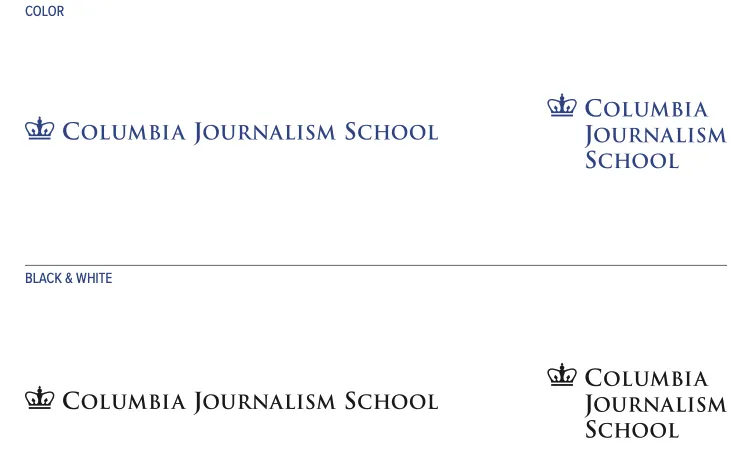
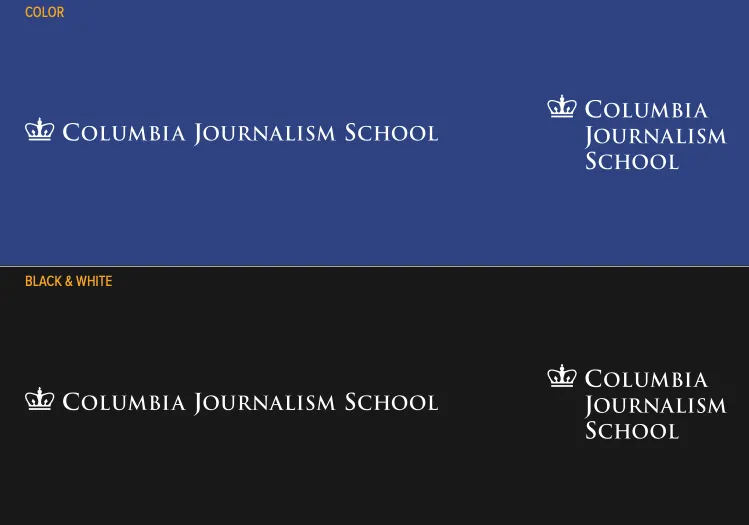
Do not change any trademark elements. The trademark must be on a white, a black or an approved blue background. The trademark must also be black, white or an approved blue. Visit the Color section for more information.

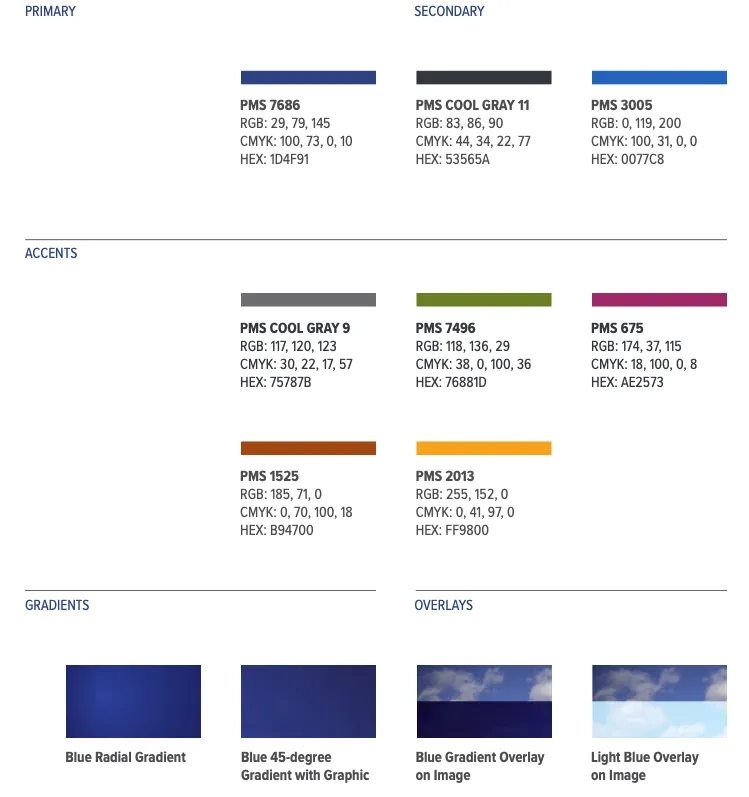
The colors of Columbia Journalism School play a crucial role in establishing a strong visual identity for our community. They are more than just a combination of hues; they embody the essence of Columbia. These brand colors are aligned with University guidelines. The Communications Department has also introduced gradients and gradient overlays to give a sense of movement to pieces of collateral. Consistency across all platforms — from logos to marketing materials — creates a memorable and unified experience for students, alumni and thought leaders in the industry.
Reminder: the Columbia Journalism School logo should only be used in brand colors and with accessible color contrast.
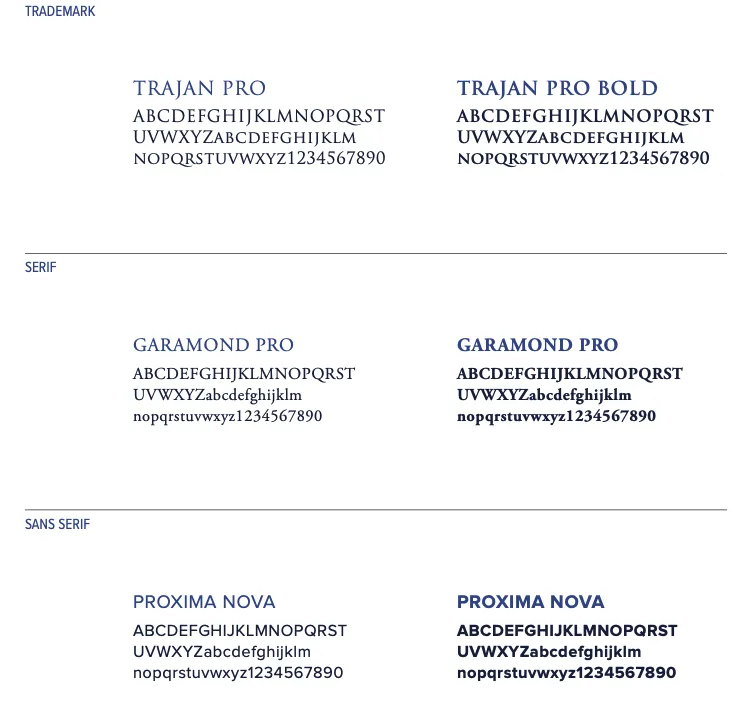
Columbia fonts are integral to maintaining Columbia Journalism School cohesiveness while establishing a distinct identity. Just as colors evoke specific emotions and associations, fonts convey a brand’s personality and values through typography. Consistent use of brand fonts across various platforms creates a unified and professional appearance that enhances brand recognition. Historically, fonts have played a crucial role in communication, particularly in newspaper printing where different typefaces were used to distinguish various sections and convey editorial tone. Today, selecting the right fonts ensures readability, reinforces brand messaging and contributes to a visually harmonious brand presence that resonates with audiences. For information about content, please reference the Columbia Journalism Editorial Style Guide.
Typefaces
Trajan Pro may be used in display typography, such as headlines, and should not be used in body copy or paragraph formats. Garamond Pro is the University’s secondary typeface and is primarily used for body copy. Proxima Nova is the official sans serif typeface of the University and is primarily used as a web font, in body copy and in headlines.
Social media sites such as Facebook, X, Instagram and YouTube are essential tools in supporting and promoting Columbia Journalism School (CJS) on campus and in the community.
The school’s promotions — from internal emails, to printables at conferences, to daily social media posts — aim to engage with Columbia audiences. This includes current and prospective students, faculty and staff, industry members, and current and potential donors. The role of the Communications Department is to serve as the voice of CJS, sharing its mission, telling its story and shaping the overall marketing and communications strategy of the school.
Official CJS social media channels are managed solely by the Communications Department.
About Columbia Journalism School
For over 100 years, the Columbia Journalism School has been preparing journalists in programs that stress academic rigor, ethics, journalistic inquiry and professional practice. Founded with a gift from Joseph Pulitzer, the school opened in 1912 and offers Master of Science and Master of Arts degrees, as well as a Master of Science in Data Journalism, a joint Master of Science in Computer Science and Journalism, the Knight-Bagehot Fellowship in Economics and Business Journalism and a Doctor of Philosophy in Communications. It is home to the Columbia Journalism Review and several world-class research centers, including the Brown Institute for Media Innovation, the Tow Center for Digital Journalism, the Ira A. Lipman Center for Journalism and Civil and Human Rights, the Simon and June Li Center for Global Journalism and the Craig Newmark Center for Journalism Ethics and Security. The school also administers many of the leading journalism awards, including the Alfred I. duPont-Columbia University Award, the Maria Moors Cabot Prize, the John Chancellor Award, the John B. Oakes Award for Distinguished Environmental Journalism, the Paul Tobenkin Memorial Award, the Mike Berger Awards and the WERT Global Prize for Women Business Journalists.