Michael Monroe, '72 M.S., and Gail Palmer Include Columbia Journalism School in Their Estate Plans to Establish the Arthur F. Monroe, Michael J. Monroe and Gail Palmer Endowed Full Professorship
Inspired by the education that shaped his career and his father’s, Monroe shares the importance of supporting a free press.
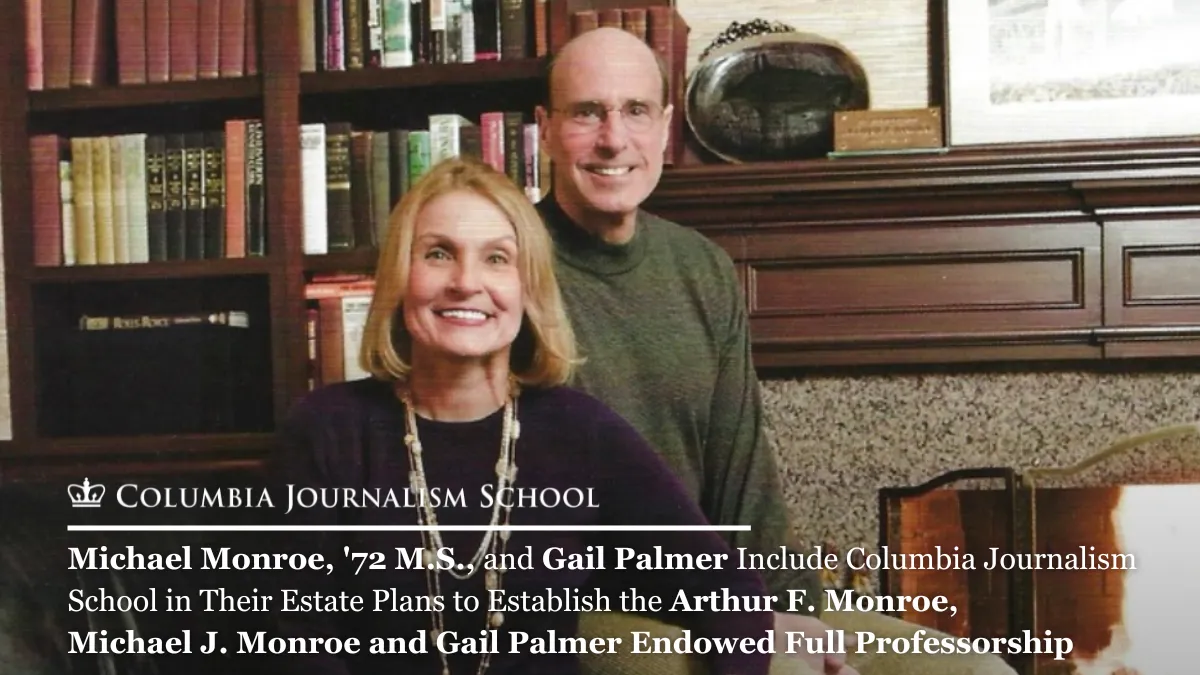
Michael Monroe, '72 M.S., and his wife, Gail Palmer, have included Columbia Journalism School in their estate plans, creating a gift that will establish an endowed full professorship in investigative and accountability reporting.
Named for the couple and Michael’s father, Arthur F. Monroe, '37 M.S., the Arthur F. Monroe, Michael J. Monroe and Gail Palmer Endowed Full Professorship will honor a family connection to the School spanning two generations.
Below, Michael reflects on his family’s connection to the School and the couple’s hopes for their gift.
What first inspired you to give to CJS and to include the School in your will?
Including Columbia in our estate planning is a simple choice for us. There is no better way to support the continued well-being of our democracy than to help maintain an institution so vitally focused on it. The important role the J-School played in both my career and my father's career also heavily influenced our decision. Neither of us would have been as successful as we were without that grounding.
What impact do you hope to see in the future through your gift?
Given how journalism and society have developed since my time at J-School, I am particularly concerned with the need to support investigative reporting. I hope that funding a full professorship concentrating on that area of expertise will help achieve that goal.
How did your father influence your decision to pursue a degree at CJS?
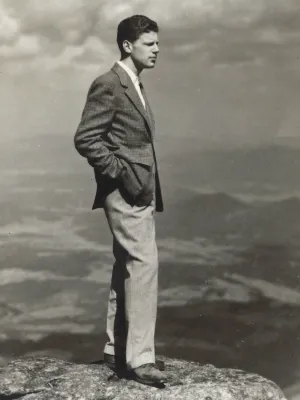
I loved and respected my dad. From a young age, I was fascinated by his career at United Press and Time magazine, and the stories he told about his friendships from Columbia, particularly with Dick Baker and David Brown. He covered Cuba for UP during the Batista regime. He told me that he always knew how difficult the political situation was by how many machine guns were posted on the roof of the Presidential Palace. My respect for my father led me into journalism, and he was immensely proud when I was accepted at Columbia.
What is your favorite memory or experience from your time at CJS? Was there a professor who had a lasting impact on you?
I took the electronic curriculum at the Journalism School, as I had already worked professionally in print at The Record in New Jersey. I thoroughly enjoyed going out in the field to do radio interviews and putting together audio stories that depended on painting word pictures. I felt it was a more interesting, creative form of writing than simply supporting video. I also relished working on my thesis, “The Murrow Men,” which enabled me to interview many of the CBS correspondents who worked with Ed Murrow. My coup was getting to interview Eric Sevareid, who was notorious for declining interviews. I camped out in his Washington office and became friendly with his secretary, who was instrumental in getting him to speak with me. Fred Friendly and Dick Baker, my dad’s classmate and a lifelong friend, were my advisors, and both were incredibly supportive. Fred, of course, with my thesis.
If you could share one message with someone considering an estate gift to CJS, what would that be?
Ensuring the financial health and well-being of an institution created specifically to train journalists in all aspects of the profession is a vital way to support our democracy and way of life. A healthy and robust fourth estate is absolutely essential.
If you are interested in including Columbia Journalism School in your will, please reach out to Katja Hafendoerfer, Senior Director of Development: [email protected].