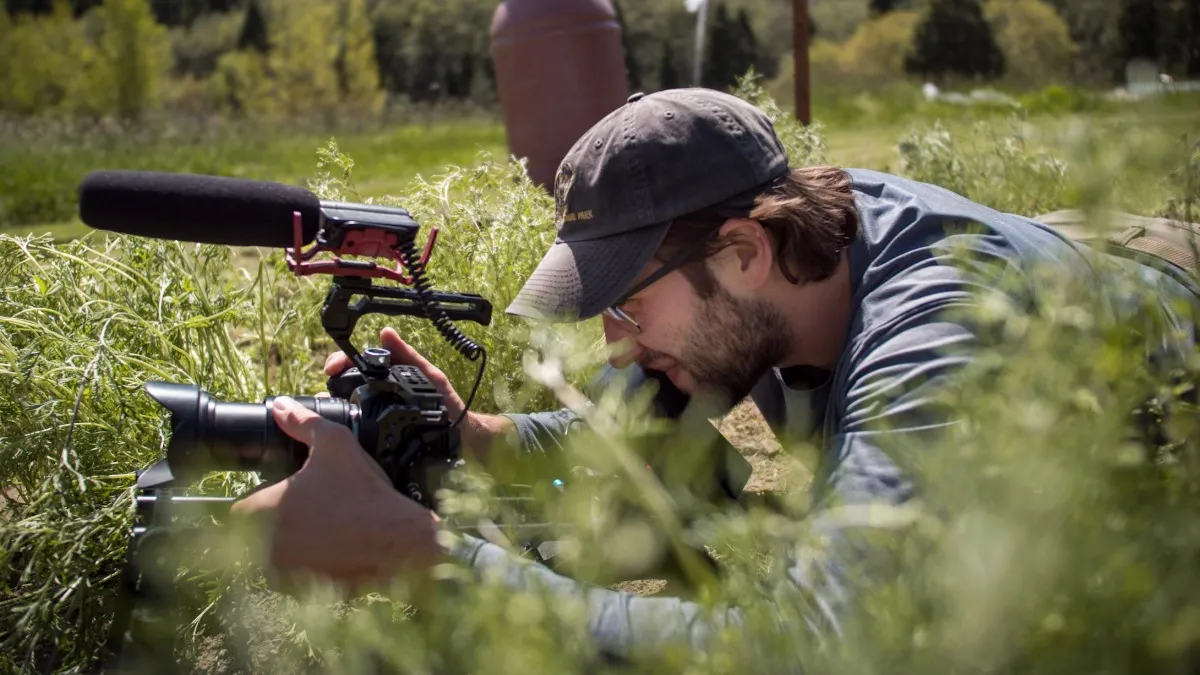
Nathan Keowen
Hometown: Sacramento, CA
Undergraduate Major: Film Production and Screenwriting Dual Degree
Whether he’s headed to a homestead in rural California or a park in the heart of New York City, Nathan Keowen, ‘26 M.S. Documentary, never leaves his camera behind. Because, to Keowen, any moment is valuable enough to document.
What led you to journalism? Was there a moment when you knew this was the work you wanted to do?
My undergraduate program was for film production. I became dissatisfied with the stories we told in class, in terms of their impact. I really wanted to find something that was a little more meaningful than what I was doing. A lot of my friends got into commercial work, but I got on the road. I lived on a goat farm and a homestead, a commune. A few months later, I decided to interview the two elderly homesteaders I had been living with. I started asking questions that I hadn’t asked them before. “How did you start?” “Can I see your pictures?” We pulled their whole life story out. And I never would have asked those questions if I hadn’t had a camera. And so it felt like it was a vehicle to have really meaningful relationships.
What drew you to Columbia, and how did you imagine this experience would shape your storytelling?
Everyone was talking about Columbia. And Columbia is the place. I was a semi-professional documentary filmmaker, but I didn’t have the final piece of the puzzle to be able to turn it into something real. Columbia has given me the opportunity to work with people and learn alongside other people, because I was doing it on my own.
Has there been a moment at Columbia that’s really stayed with you, something that changed how you think about reporting or storytelling?
It was week two, and a classmate and I were put out on a man-on-the-street assignment. The question we were supposed to be asking everybody was, “When did you recently change your mind?” We went out to Harlem and spoke to a man in the park. He replied, “Last night. I changed my mind and finally told my parents about my suicidal ideation.” We had a long talk about mental health and his relationship with suicide. His parents were in tears. It got so much deeper than I think any of us expected. We had initially pitched it to him as, “Oh, we’re just doing a student project.” He said, “No, this is bigger than that.”
Tell us about a recent story or project that’s meant the most to you. What drew you to it, and what did you take away from it?
That same interview assignment in Harlem means the most to me. We learned, in week two of the program, that any moment can be valuable. The man ended the interview by saying, “You guys have changed my life today.” He changed ours.
When you think ahead, what kind of journalist do you hope to become, or what kind of impact do you hope your work will have?
For me, documentaries are about personal narratives. The kind of documentaries I want to do are really focused on personal narratives. I want to follow one person. To understand the “why” of that person, of certain experiences in someone’s life. Being someone that understands how to tell those stories in an engaging way, turning a passion into a career, is who I hope to be.