Julie K. Brown’s Address to the Columbia Journalism School Class of 2026
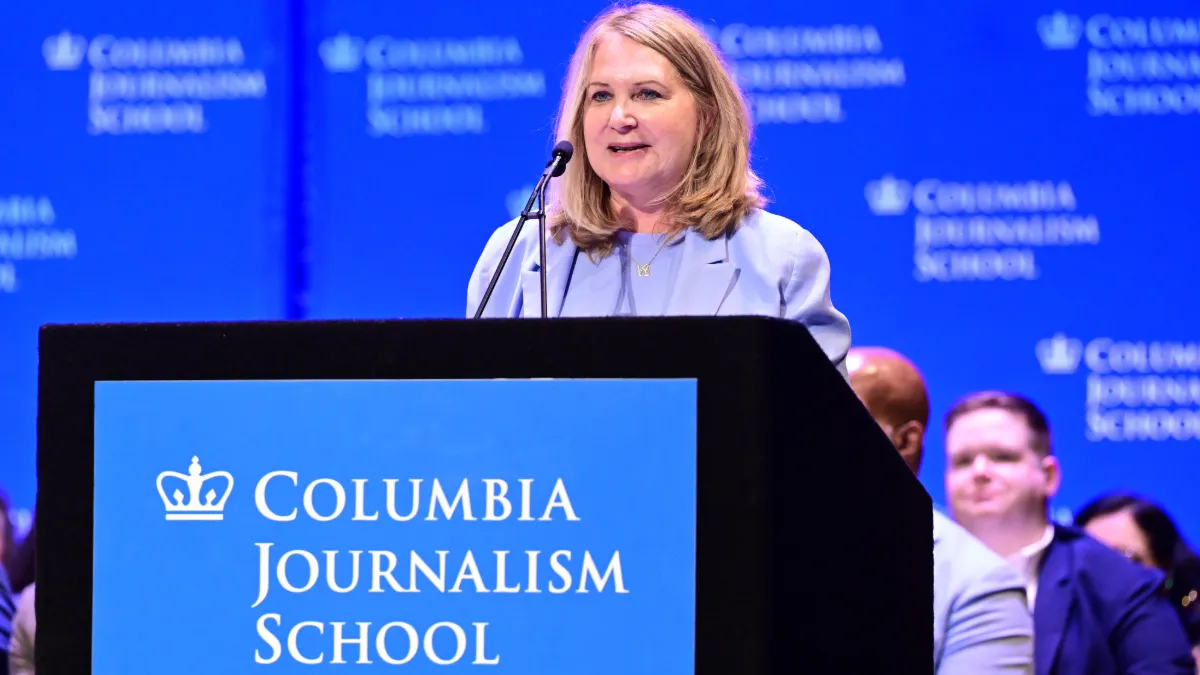
During the Class of 2026 Graduation Ceremony, graduates, faculty and families gathered to hear from 2020 Columbia Journalism Award recipient Julie K. Brown.
Brown received the award during the height of the COVID-19 pandemic, when graduation ceremonies were held remotely. She was invited to speak to this year’s graduating class to share insights from her extensive investigative journalism career, the resilience required to pursue difficult stories and the enduring importance of accountability reporting.
Read her full remarks:
Dean Cobb, faculty, events staff,
It is an honor and privilege to be asked to speak before the esteemed members of one of the finest journalism institutions in America.
Thank you, students, family and friends for welcoming me here on such a momentous occasion.
This is a celebration of all that you’ve accomplished to get here -- and an opportunity to look ahead to the life you have yet to live.
We are living in a tumultuous time when world events, propaganda, technology and greed threaten to undermine all that our nation has held dear since its inception 250 years ago this year.
Our country was built upon the idea that truth did not belong to tyrants, that power should be balanced and that all people deserve a voice.
In my lifetime, there has never been a more urgent need for journalism, or a more important time to give voice to those who have none.
Thirty-nine years ago, when I graduated from college, I could have never dreamed I would be standing here as someone who has attained some of the highest honors in journalism.
Because to get here, I did not travel a traditional path. In some ways, it’s a miracle that I ever made it here at all.
I faced a lot of obstacles that has tested my faith in journalism and the meaning of life itself.
All the people who told me I couldn’t do what I wanted to do, and the doors that closed for me – all taught me something important: it made me a fighter.
I grew up in a small town in Pennsylvania, a place that in the 1960s wasn’t always hospitable to a single mother with three children. My mother worked two jobs to keep a roof over our head – and we were left home alone with instructions to never to answer the door.
One time, when she couldn’t pay the electric bill, someone came and took all our furniture, so we slept in the car in our driveway.
There were other things that happened in my life that led me to leave home at the age of 16 and become an emancipated minor.
I lived with friends and worked through high school as a store clerk and later, as a waitress. I delivered flowers and worked in the assembly line of a lampshade factory. I did this for four years between high school and college.
Finally, I decided I wanted to do something meaningful with my life. I applied for loans and grants to attend college at Temple University in Philadelphia.
I briefly considered going into public relations or business because I had doubts that I would ever make a living as a working journalist.
But I was determined to expose the unfairness in the world suffered by people of color and others even more underprivileged than I.
After graduation, for years, like my mother before me, I worked two jobs to pay my rent, while climbing the ladder from one small paper to the next.
I had good days and bad days. Often, in journalism, it feels like you’re only as good as your next big story.
I channeled some of my insecurities and anxiety into telling the kinds of stories that I found rewarding, the kinds of stories that helped make one person’s life a little better.
It provided me a sense of purpose I had never felt before.
I became relentless. I also broke a few rules, like heading to a crime scene without telling my editor, sneaking into a hospital room to get an exclusive interview with the ailing boxer “Smokin” Joe Frazier.
I covered mob hits and the plane crash in Martha’s Vineyard that killed JFK Jr.
More often, I was pursuing a story that I believed in when no one else did. I had to prove to my editor, with reporting I did on my own time, that I had a story that needed to be told.
I wrote about firefighters who were going untreated and dying from hepatitis C, cops who were arresting people because they were working while black and inmates in Florida state prisons with mental illnesses who were being tortured and killed by corrections officers.
When I took up the Jeffrey Epstein case in 2016, many said it wasn’t a story. They said that there was nothing new. But to me, the stories that were written over the years about Epstein never explained how and why he was able to get away with his sex crimes and harm so many young girls with impunity.
Talking my editor into letting me examine this well-worn case was one obstacle, finding the victims was another, then getting them to publicly share the worst thing that had ever happened in their lives was even more daunting.
I wasn’t afraid of Epstein
or his high-powered lawyers. Because by then, I had faced so many obstacles in my life and career that I was determined to take a fresh look at this story.
I envisioned myself as a cold case detective and pulled all the records.
(And nothing in this project was done with A.I.)
I read every police report and every interview; I read every court deposition and lawsuit; I interviewed the lead police detective and examined more than 10,000 pages of FBI and Justice dept. files.
Everything that I went through and learned about journalism had prepared me for this battle.
For the first time, these young women described how they had been betrayed by the very system of justice that was supposed to protect them and hold Epstein and the other people involved in his crimes accountable.
I was also able to show the imbalance of power: how prosecutors covered up the scope of Epstein’s crimes, so that no one -- and especially not the victims or the public -- would be able to fully understand the enormity and vast reach of what he had done.
My series “Perversion of Justice” was published by the Miami Herald in 2018, and for a time, captured the world’s attention.
Still, many in mainstream journalism dismissed it as an old story. Some journalists even went so far as to go on social media and publish previous stories that had been written -- just to diminish what I had accomplished.
But to me, my work was just beginning. There was still more to expose about Epstein – and the other men and women who enabled or participated in his crimes.
So, I kept digging and writing.
Eight months after my series ran, Epstein was arrested, and the prosecutor who gave him that sweetheart deal a decade earlier resigned as secretary of labor. Epstein was then found dead, his accomplice, Ghislaine Maxwell, was arrested, tried and convicted.
End of story, right? More years went by. The media moved on to other important stories.
But I kept digging and writing, for SEVEN more years. There were still so many unanswered questions – about his connections and how he got so wealthy and powerful. The public demanded more answers.
At the start of Donald Trump’s second term as president, attorney General Pam Bondi vowed she would release the FBI case files. Then she changed her mind. There was nothing to see, she said. Old story. President Donald Trump called it a hoax.
But Epstein’s survivors, some of whom mistakenly believed they were alone in the sexual abuse they had suffered, united for the first time, and demanded justice. Congress took notice.
The justice department’s files were finally released earlier this year – and for the first time, everyone could see for themselves how our country’s guardians of justice had squandered almost every opportunity to protect other girls and young women from a known sex predator.
The case has come to epitomize our nation’s lopsided system of justice, and how victims of sexual abuse are discredited, discarded and shamed by the public.
How protecting the powerful takes precedence over truth, fairness, compassion and morality.
When I became a journalist, I learned that the most rewarding part of my work was in righting wrongs – especially for those who could not fight for themselves.
Few people were able to recognize that Epstein not only beat the system -- but he was still hunting and abusing more victims.
I faced many obstacles to expose this truth. I was attacked by legal forces, by former prosecutors and defense attorneys. Ghislaine Maxwell and by some of those in my own industry who thought all I did was rehash history.
All of this tested my resilience and sometimes even my mental health.
But I successfully balanced being a single mother with a meaningful career. I have many people to thank for this – and you will too.
Start by thanking those around you today.
As journalists, we have the power to make people see something in the world that they otherwise would have never understood or known about without you showing it to them in a different way.
We cannot put aside this calling, even if people tell us the story has already been told.
Because this was – just. One. Story. -- that is still not finished. There is one person who recognized the power of my work Before his arrest, Jeffrey Epstein had pondered several ways to discredit my work. He wanted to meet with me, try to get me to write a positive story about him. He seemed to understand that I didn’t intend to stop investigating him and his friends.
He told one of his lawyers in an email: “She is going to start trouble.”
So let that be my last words to you.
Get out there -- and start some trouble!!
Deepest congratulations, to the class of 2026.