Columbia Journalism Review to publish special issue— Journalism 2050—envisioning what journalism could look like in a quarter century
Journalism 2050 is a project from the Columbia Journalism Review and the Tow Center for Digital Journalism, with support from the Patrick J. McGovern Foundation.
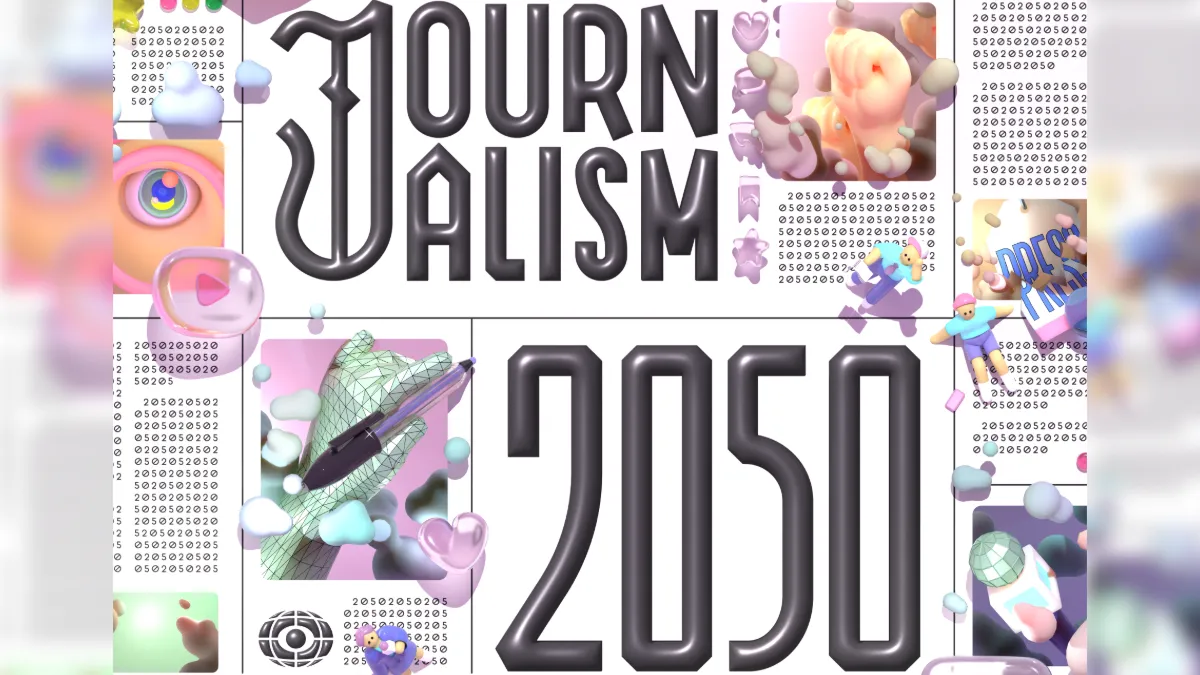
A new special issue of the Columbia Journalism Review is a pioneering effort that envisions how the fast-changing state of journalism could evolve in the next 25 years.
What will the profession look like then? How will readers interact and experience news? Which media outlets and social media will—and won’t—survive? Will network news even be around? How could AI alter the presentation and consumption of news?
Journalism 2050 explores each of these questions and much more in a substantial issue dedicated to considering the future of news and, by extension, the foundations of our society.
“We do not know what exactly the future holds, much as we may want to believe we do,” CJR Editor in Chief Betsy Morais writes in her introduction to the issue. “Journalists feel this tension all the time: the desire to serve audiences the impossible answers they seek, tugging against the humility required to remind them we can’t. There are a lot of unknowns about the next twenty-five years. But we can, at least, dress for the weather.”
The issue includes reported features, columns, interviews, and an accompanying podcast series diving into the questions and challenges facing the field and imagining the possibilities as well as the dangers ahead.
Stories include:
- A feature examining major news organizations and leading journalists, postulating which outlets, figures and tentpoles will still be here in a quarter century. What will remain of the existing institutional, or old, media?
- An interview with Liz Kelly Nelson, founder of Project C, aimed at helping journalists navigate the independent creator economy through a newsletter, courses, research and a members-only Slack community.
- Joel Simon on Perez Hilton—whose recent legal battle put his journalistic status to the test. Members of the traditional press and news influencers should be equally concerned about the outcome. .
- A probing piece about DeeperDive, a generative AI widget designed to surface links to relevant articles from across a publisher’s site. What does the embrace of this technology by USA Today Co. (formerly Gannett) mean for local news? What are the lines we’re willing to draw around where AI can and cannot go at the community-information level?
- An essay by Kyle Paoletta on the direct-to-consumer model practiced by President Trump to bypass traditional media by using social media to communicate with his supporters. What does this practice mean for the future of the press? Will the old rituals of campaigns and covering the White House ever be the same? And how are journalists adapting this model for their own purposes?
- Maddy Crowell on Lex Fridman, an MIT computer scientist who runs one of the most listened-to podcasts in the country. This profile examines the popular podcaster, who doesn’t fit into any political box and interviews pretty much anyone about anything—including guests traditional members of the press can’t reliably reach, such as Trump, Modi, Zelensky, and Netanyahu—allowing his subjects to speak largely uninterrupted for hours on end about their lives and their views.
- How does a journalist becomes an influencer? Yona TR Golding explores the shift from major news organizations to self-directed content creators, looking at high-profile folks who have done this, from Mehdi Hasan to Taylor Lorenz to Chris Cillizza.
Columnists also explore the trap posed by debunking as fact-finding for the reaction economy, the futility of efforts by a fed-up public to avoid the news, what the attacks on press freedom in Gaza portend, and what an AI takeover of journalism could mean.
And in the Journalism 2050 Podcast—hosted by Emily Bell, who leads Columbia’s Tow Center for Digital Journalism, and Heather Chaplin, from the New School’s Journalism + Design Lab—talk with the smartest minds in media about how we got here and where journalism is headed.
______________________________________________________________________
About Columbia Journalism School
For more than a century, Columbia Journalism School has been preparing journalists in programs that stress academic rigor, ethics, journalistic inquiry and professional practice. Founded with a gift from Joseph Pulitzer, the school opened its doors in 1912 and offers a Master of Science, Master of Arts, a joint Master of Science degree in Computer Science and Journalism and Doctor of Philosophy in Communications. It houses the Columbia Journalism Review, the Brown Institute for Media Innovation and the Tow Center for Digital Journalism. The school also administers many of the leading journalism awards, including the Alfred I. duPont-Columbia University Awards, the Maria Moors Cabot Prizes, the John Chancellor Award, the John B. Oakes Award, the J. Anthony Lukas Prize Project, Paul Tobenkin Memorial Award and the Meyer “Mike” Berger Award.
About the Columbia Journalism Review
Columbia Journalism Review was founded at the Journalism School in 1961 and publishes a biannual magazine that analyzes news and media trends, acts as a watchdog for professional ethics, and tells the stories behind the news. It is the most respected voice on press criticism and shapes the ideas that make media leaders and journalists smarter about their work. Through fast-turn analysis and deep reporting, CJR is an essential resource not only for journalists but also for thousands of professionals in communications, technology, academia and other fields reliant on solid media industry knowledge.
About the Tow Center for Digital Journalism
The Tow Center for Digital Journalism, established in 2010, provides journalists with the skills and knowledge to lead the future of digital journalism and serves as a research and development center for the profession as a whole. Operating as an institute within Columbia University’s Graduate School of Journalism, the Tow Center is poised to take advantage of a unique combination of factors to foster the development of digital journalism. Its New York location affords access to cutting-edge technologists, a strong culture of journalism and multiple journalism and communication schools, with outstanding universities attached to them. The Tow Center is where technology and journalism meet, and where education and practice meet.
About the Patrick J. McGovern Foundation
A global, 21st century philanthropy, the Patrick J. McGovern Foundation is committed to bridging the frontiers of artificial intelligence, data science, and social impact. The Foundation is the legacy of IDG founder Patrick J. McGovern, who often said, “The best is yet to come.” He recognized the potential for information technology and neuroscience to democratize access to knowledge, improve the human condition, and advance social good. A generation of rapid advances in technology have led us to new possibilities at the intersection of information technology and neuroscience — artificial intelligence and data science. The promise of AI and data science represent the future Patrick J. McGovern always envisioned. With his optimism about what is possible, the Foundation invests in the exploration, enhancement, and development of AI and data science for good.