Urgent Ideas for Defending Press Freedom in Gaza
CJS faculty and graduates explore urgent strategies for protecting journalists in Gaza.
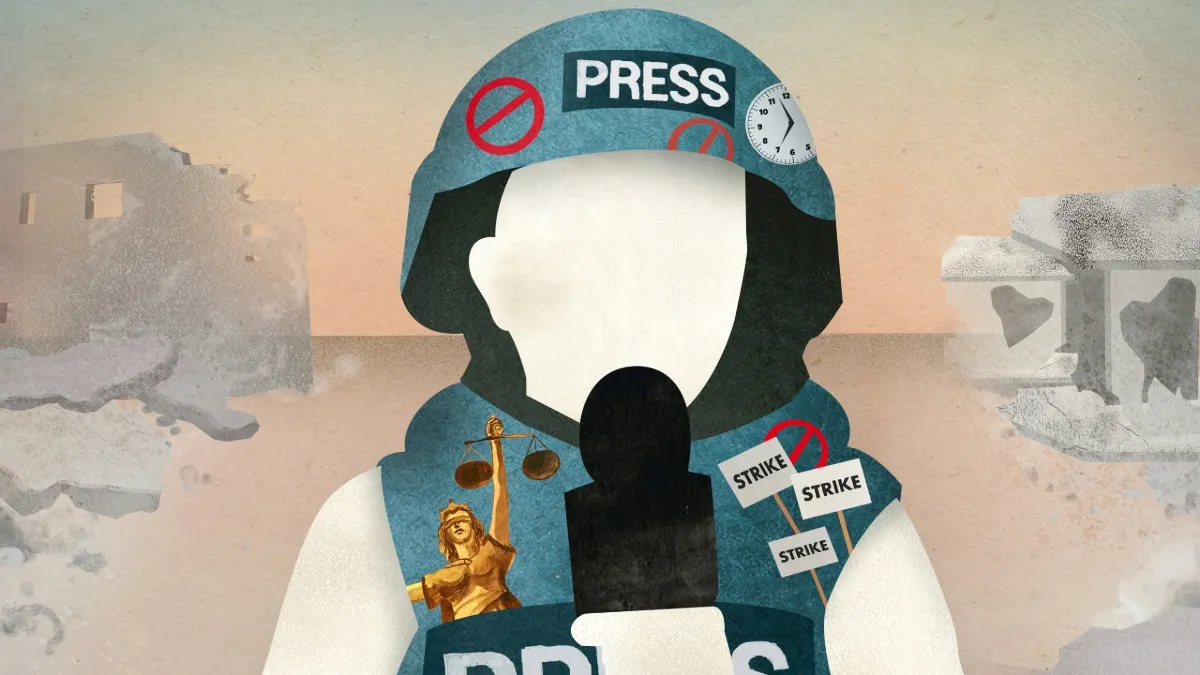
Last Sunday night, the Israeli military targeted Al Jazeera’s most prominent journalist still alive in Gaza, Anas al-Sharif, killing him, three colleagues, and two freelancers inside a tent used by media workers near al-Shifa Hospital. I write “still alive” because, according to data from the Committee to Protect Journalists, Israel has killed nineteen Al Jazeera staff journalists and freelancers in Gaza since the war broke out. The total number of Palestinian journalists that CPJ has recorded killed by Israel in Gaza during this period—a hundred and eighty-four—exceeds all previous records the organization has tracked, and local press freedom groups that are entrenched on the ground, such as the Palestinian Journalists’ Syndicate, put the figure even higher, at well over two hundred. At least twenty-six of these killings CPJ has identified as deliberately targeted—often, as with al-Sharif, on the basis of “unsubstantiated terrorist labels.”
At this point, to the millions who have spent the past twenty-two months closely watching the journalism of al-Sharif and the media workers killed with him—correspondent Mohammed Qreiqeh, camera operators Ibrahim Zaher and Mohammed Noufal, and freelancers Moamen Aliwa and Mohammad al-Khaldi—their killing seemed an obvious effort to snuff out the widest-reaching news broadcast from the ground ahead of the Israeli government’s plans to take over Gaza City.
The assassination may not have come as a surprise. Throughout this period that a growing consensus of experts on human rights and international law label a genocide—a term many journalists are punished for using—we have repeatedly witnessed record new threats to press freedom. For nearly two years, Israel and Egypt have not allowed foreign journalists to access Gaza for independent reporting, outside of choreographed Israeli military embeds. Palestinian journalists have been subjected to relentless pressure from pro-Israel advocacy groups that dub themselves “media watchdogs” and wage systematic campaigns, fomented by Israeli intelligence, to discredit, dehumanize, and blacklist them—and to harass those who defend them. We have heard the pleas of starving journalists who are displaced and exhausted, dozens of kilograms lighter in weight but immeasurably heavier of heart, with no hope for colleagues to come in and relieve them of the reportorial burden they shoulder alone. And the list grows of journalists whom Israel has publicly declared “terrorists” and then, as my colleague Aida Alami put it to me, “hunted like rabbits.”
These threats to press freedom are urgent for every journalist still somehow managing to work in Gaza. They also have long-term consequences for distrust in our media institutions and for precedents that might jeopardize the safety of journalists elsewhere, anywhere in the future. Among both news consumers and members of the profession, many have noted the muted responses of governments as well as journalism organizations—which have not been inclined toward collective action or direct appeals, but often focus coverage on, for instance, poorly evidenced accusations that someone Israel killed was a combatant, rather than well-documented evidence of that person’s work as a reporter. A growing number have come to view this, ultimately, as a failure to contend with man-made human catastrophe in Gaza, including for reporters—and it has marked a breaking point in their relationships with legacy news institutions.
Amid these dire threats, individual journalists, press freedom groups, and some newsrooms have drawn upon the traditional tools in their advocacy arsenal: letters, statements, condemnations, and the occasional slow-moving Israeli court case challenging lack of access. None of these efforts has resulted in change. “We’ve passed the point of verbal condemnation,” Youmna ElSayed, Al Jazeera English’s Gaza Strip correspondent, told me. She and others have been pushing for creative solutions that have gone unheeded. This summer, the Columbia Journalism Review and the Simon and June Li Center for Global Journalism solicited thinkers from across the fields of journalism, human rights, literature, academia, and advocacy, asking them for ideas about what new strategies, efforts, and possibilities should be on the table for our industry at this moment. We asked people for innovative, perhaps unconventional ideas to defend press freedom in Gaza. These were their answers.
—Azmat Khan, Patti Cadby Birch Assistant Professor of Journalism; director, Simon and June Li Center for Global Journalism at Columbia Journalism School