Sahan Journal Receives the 2026 Columbia Journalism Award, Director of Editorial Chao Xiong Delivers Keynote Address
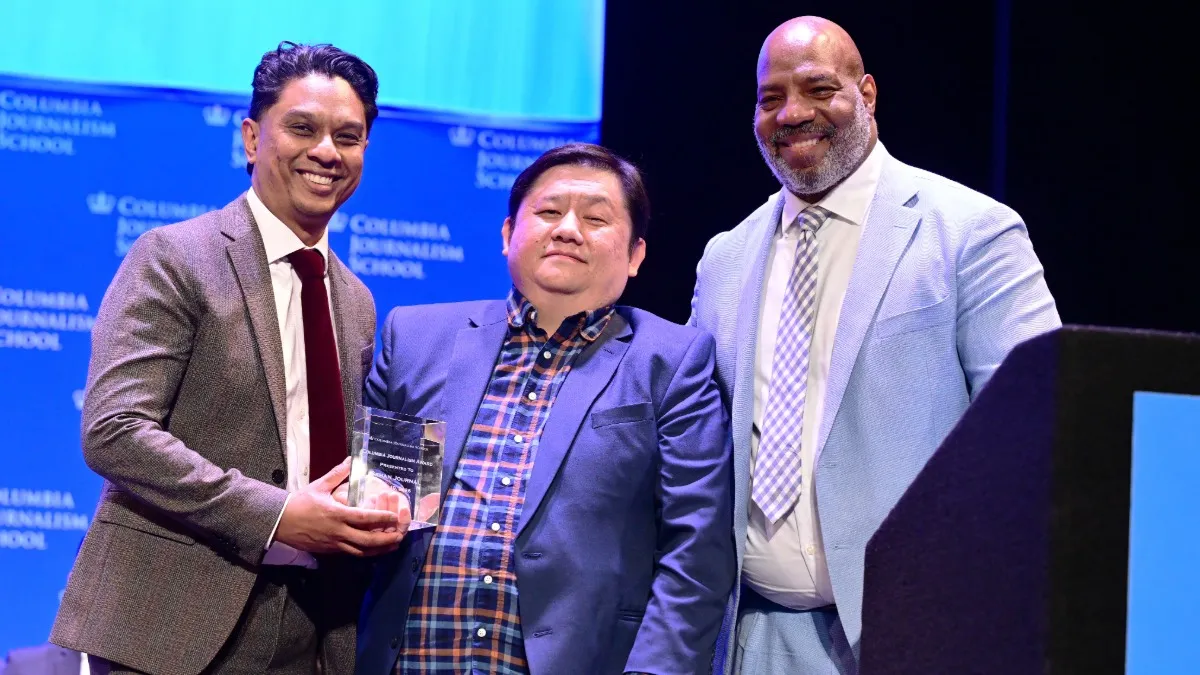
Each year, CJS faculty present the Columbia Journalism Award, the School’s highest honor, to a journalist or organization whose career reflects the highest standards of excellence in the field. This year’s honoree is the nonprofit newsroom Sahan Journal. Chao Xiong, Director of Editorial for the publication, received the award and delivered the keynote address to the Class of 2026.
Read his full remarks:
Thank you so much for recognizing Sahan Journal with the Columbia Journalism Award, and for having us here today. It’s an honor to receive the award, and to join you for the 2026 commencement. I want to recognize the incredible team at Sahan Journal that made this possible, and I want to dedicate this award to the brave people of Minnesota who shared their stories with the media when they had nothing to gain from it. The first few months of this year show just how vital a robust independent media is to our democracy, and how much we need all of you right now.
I’m standing in front of some of the most talented and ambitious young journalists in our country. You’ve just spent nine months living and working in one of the most exciting cities on earth, and I’m urging you now: LEAVE. Go and share your curiosity and talent with the rest of the world. Great journalism is happening everywhere — the Midwest, small towns, nonprofit newsrooms, maybe even the place you were born and decided to leave behind forever. It is not the place, but the person that determines what is possible.
Let me make the case for local journalism — for being the kind of journalist who lives in the community you cover, for being the kind of journalist who brings your lived experiences to the table to reform an industry that historically marginalized people of color, women, the LGBTQ community, immigrants and others. I was working as a reporter for the Minnesota Star Tribune in 2020 when thousands of people gathered on the streets of south Minneapolis to protest George Floyd’s murder. While most were peaceful, some looted and burned storefronts that first night just blocks from my home.
As I reported for work the next morning, I drove over a bridge that crossed over the heart of the protests. My eyes unexpectedly welled up with tears as I surveyed the damage in the daylight. You’re a journalist, I thought to myself. You’re not supposed to cry. For a moment, I was filled with shame. But this was my neighborhood. This was my home.
I spent the next three nights covering the protests. I completed a regular 9 to 6 shift at work, went home, packed my goggles and face mask and walked four blocks to cover the protests well past midnight. One night, I interviewed a man who stood protectively in front of a public library as a pawn shop burned a few buildings in this direction and a liquor store burned a few buildings in that direction. “This is my neighborhood,” he said. “This is my neighborhood, too,” I replied.
We’re building a newsroom at Sahan Journal that reflects Minnesota’s diverse communities, which positioned us to respond to the recent federal immigration operation. Our immigration reporting is led by Katelyn Vue, a second-generation Hmong American who was born and raised on St. Paul’s East Side.
Last fall, a woman read Katelyn’s story about the detention of Hmong Minnesotans over the phone to her husband as he sat in jail awaiting deportation. That man called Katelyn immediately afterwards, urging her to tell his story, and to publish Ring doorbell video of his arrest to show the world how our government was tearing families apart.
Two international students who graduated from Columbia and joined Sahan’s staff — Cynthia Tu, class of 2023, and Shubhanjana Das, class of 2025 — brought invaluable firsthand experiences to our coverage of the government’s crackdown on international students, who were among the first targets when the enforcement began last year.
I had been working in legacy media for 18 years when Sahan Journal founder Mukhtar Ibrahim, a 2017 Columbia graduate who’s sitting behind me here, contacted me in 2022 about joining his nonprofit newsroom. I took a leap of faith, leaving a newsroom with more than 200 staffers to become the 11th employee at Sahan Journal. As a second-generation Hmong American, Sahan and Mukhtar’s unapologetic vision of a more inclusive journalism felt like rain in the desert.
Who you are is valuable to the journalism you create. It’s not biased or unethical to tap into your experiences, humanity and compassion to build trust with people, and to tell more nuanced, culturally competent stories. It’s necessary.
While there are questions about what the future of journalism will look like, I have no doubts that it will endure, and that people are hungry for what your imagination dreams up. You carry a device in your pocket that gives you nearly every tool necessary to create content across myriad platforms at no cost. You can reach someone half way across the world in a matter of seconds. People can share your work quicker and more widely than when I graduated from journalism school 23 years ago without a cellphone or social media profile, waiting for someone to give me a job working the night shift or weekends chasing police sirens to prove myself.
Don’t wait for someone to give you a job to practice journalism. Create your own opportunities. Follow your curiosity. Show the world what you can do. Your generation will shape the future of journalism. This is not the time to wring your hands. It’s time to innovate and lead. Don’t fret about whether video will eclipse the written word. The art of storytelling has persisted for millennia, and it will continue to persist in spite of the latest digital trend.
Your words will find their place. It is not the platform, but the person that determines what is possible. The true work of journalism is often invisible. No one is watching, and you will not be rewarded for most of it. Yet you must show up every day.
Only when you’ve built the habit of showing up in those quiet moments will you be positioned to see faults in the system, identify abuses of power and earn the trust of sources whose stories are capable of cracking the universe open.
As journalists, we’re trained to focus on conflict. I’m asking you to see the good, too. On the second day of protests after George Floyd’s murder, a group of Black mothers set up folding tables in the street and distributed free milk, diapers and groceries in front of two stores that had been looted.
Before the Fifth Precinct police station was set ablaze, a group of Black elders stood in the sun for hours, elbows linked around the front of the building in a human chain to keep people out and to remind police that the streets belonged to the community. I witnessed protesters tending to a man with bloody stab wounds in his abdomen. The alleged attacker emerged from behind a building across the street, and without planning or use of force, dozens of men formed a circular human wall around the suspect until police were able to arrest him and rescue the victim with zero conflict from protestors.
While I shared these stories in real time on my Twitter feed, I regret not making the time to memorialize them in the newspaper or its website – to balance the narrative that still persists today that those inconceivable nights in Minneapolis were only filled with violence and destruction.
You are the eyes and ears of history. Do not forget the stories that remind us of our innate kindness and humanity.
Graduates, take a minute and look around at your peers. This work will test you, and ask you at times to put your life in the path of danger. We saw that this year in Minneapolis, a surreal callback to similar dangers journalists faced covering George Floyd’s murder six years earlier. You will encounter the full expanse of the human condition in all its confusing brilliance and complexity, and you will witness heartbreak more times than you think possible.
So remember these faces. Check in with each other. Take care of each other. And if you ever find yourself crying alone in your car on the way to work, reach out to someone. Please.
Class of 2026, welcome to the rest of your big, beautiful and exciting lives. I can’t wait to see what you accomplish! Congratulations!