The Brown Institute for Media Innovation Awards 2026-2027 "Magic Grants."
This year's projects cross both campuses and blend journalistic insight with technical innovation.
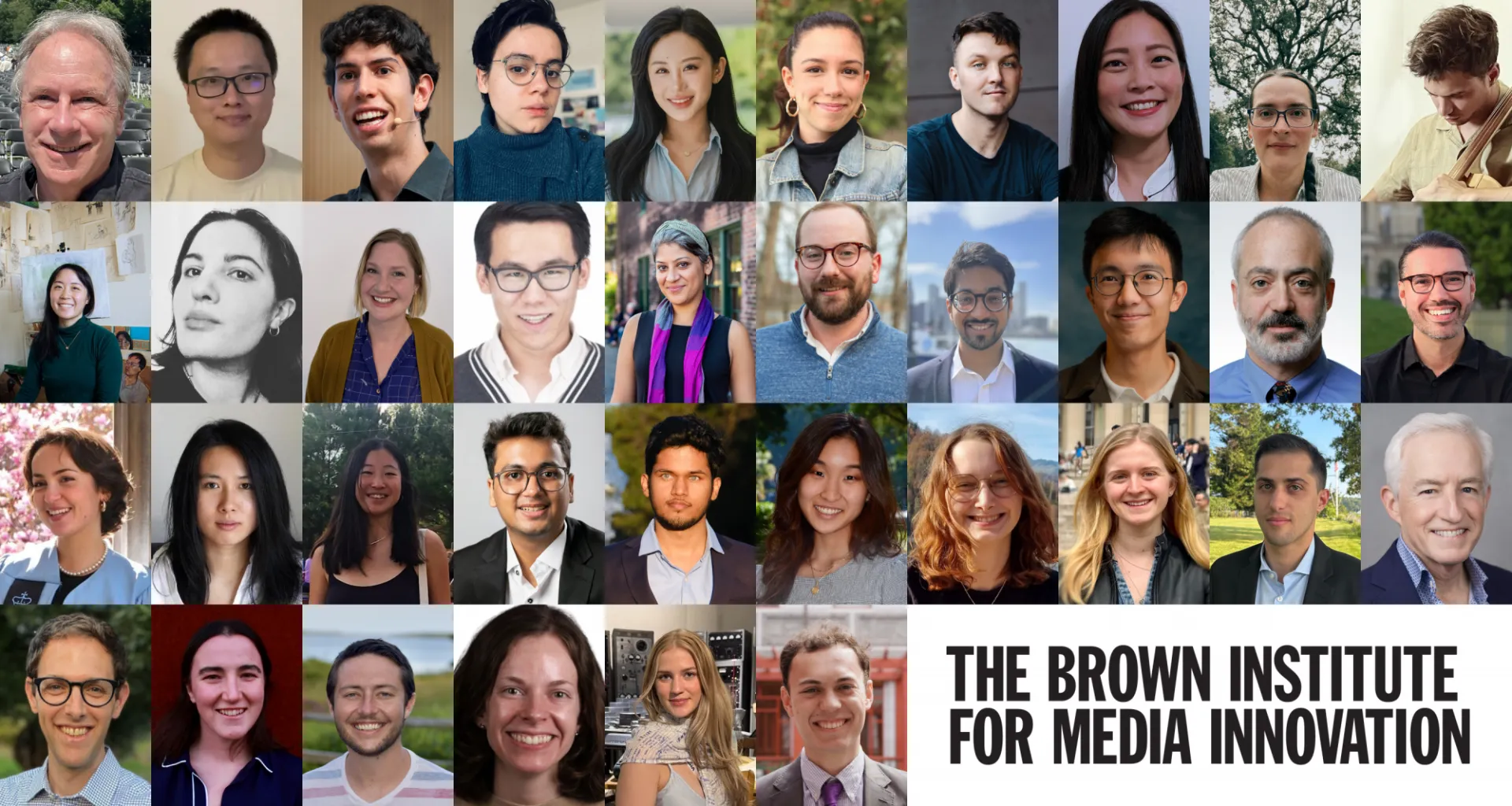
This year, the Brown Institute for Media Innovation awarded its 15th cohort of Magic Grants. The winners proposed new work in investigative reporting, civic technology, accessible technology, public health and tools for creative work. Two of this year's grants are bicoastal, with collaborators based both at Stanford University and Columbia University. The funded projects include:
- BLIND ENVY, which has proposed a set of tactile audio tools designed for blind creators, making professional audio production more accessible;
- Testing Soil and Water Near Aging Cold War-era Nuclear Weapons Sites, a partnership between Columbia Journalism School and the Mailman School of Public Health to produce the first comprehensive assessment of contamination risks facing residents near America's Cold War-era nuclear weapons sites; and
- VibeAnimation a tool that will let animators, designers, and journalists teach AI models motion graphics styles through demonstration.
Together, the Brown Institute made 11 awards (9 full Magic Grants and 2 Magic “Seed” Grants), each project exemplifying Brown’s commitment to matching emerging technologies with impactful stories.
“I’ve been with Brown since its founding, and I’m proud of the special grant program we’ve built. Year after year, I’m amazed by the creativity and ambition of the people who apply,” said Mark Hansen, East Coast Director of the Brown Institute. “With each Magic Grant, we’re supporting thoughtful invention.”
Predictably, a current of AI ran through this year's pool of Magic Grant applications, but the framing was distinctive. More submissions than in any previous year treated the technology as a research subject rather than an off-the-shelf tool, with teams proposing new evaluation methods, exposing the failure modes of current systems, or pursuing original approaches to problems that existing tools handle poorly.
The grantees funded share a common conviction that AI is most useful when it is built carefully, evaluated rigorously, and deployed with clear purpose, and that many of the hardest open problems are less about scale than about reliability, control, and trust.
“Many of this year’s Magic Grant projects are developing new and thoughtful ways of working with AI to create media. Ways that leave humans with the decision-making control while letting AI handle routine and tedious aspects of the work,” said Maneesh Agrawala.
Established in 2012 with a generous gift from the famed Cosmopolitan Magazine editor Helen Gurley Brown, the Brown Institute honors the memory of Helen's late husband, David Brown, a film producer and alumnus of both the Columbia Journalism School and Stanford University. The institute is committed to fostering unique interdisciplinary collaborations, sparking the "magic" that arises from combining diverse perspectives and expertise.
We extend our congratulations to this year's Magic Grant recipients. It's a privilege to support your visionary projects, and we can't wait to see the stories, insights, and innovations you will bring to life in the months ahead!
2026-2027 MAGIC GRANTS
ActionCut: Computational Support for Editing of Action Scenes (Stanford)
Jean-Peïc Chou, PhD Candidate in CS (Stanford)
actionCut is a computational editing system that helps creators quickly explore different ways to cut an action scene, where decisions about pacing, clarity, continuity, and impact all have to work in concert. Most existing tools in this space focus on dialogue, leaving the editing of physical movement, including fights, chases, and choreographed sequences, largely unaddressed. By studying how professional editors actually assemble action and identifying the rules and recurring patterns they rely on, the team will produce both a framework for the craft and a prototype system that lets creators generate, compare, and refine candidate edits from raw multi-angle footage.
Arbiter: Cross-Platform Investigative Infrastructure for Local Journalism (Columbia)
Chaitya Shah, M.S. Candidate in Data Science (Columbia); Ethan Sheinker, MPA Candidate (Columbia); Swapneel Mehta, Co-founder of SimPPL; Advised by Diane Chang, Brown Institute Entrepreneur-in-Residence (Columbia)
Arbiter is a cross-platform investigation tool that helps local journalists trace narratives, networks, and influence operations across nine major social media platforms, from X and TikTok to Reddit and Telegram. Built by the nonprofit SimPPL to fill the void left by CrowdTangle's 2024 shutdown, the project will advance new methods for cross-platform retrieval, theme discovery, and AI agent evaluation, then pilot the toolkit with local newsrooms covering the U.S. midterms to produce evidence-backed investigations of digital manipulation. Every output includes its full reasoning and source posts as a verifiable evidence chain, equipping reporters without technical backgrounds to investigate stories that today move faster than any single newsroom can follow.
BLIND ENVY (Bicoastal)
Calvin Van Zytveld, Ph.D. Candidate in Musicology (Stanford); Lemon Guo, DMA Candidate in Music Composition (Stanford) and MFA '18 in Sound Art (Columbia); Celeste Betancur, Ph.D. Candidate in Computer-Based Music Theory and Acoustics (Stanford); Bhavya Shah, BS/MS Candidate in Computer Science (Stanford); Elyse Blennerhassett, '18 M.S. in Oral History and Journalism and MFA '18 in Sound Art (Columbia); Ariana Martinez, Lecturer in Media Arts (Rutgers University); Mike Mulshine, Hardware Engineer, Ph.D. '25 in Computer-Based Music Theory and Acoustics (Stanford); Advised by Professors Chris Chafe and Jonathan Berger (Stanford)
BLIND ENVY is a pair of tactile audio tools, a field recorder and a studio editor, designed for blind creators, paired with an eight-episode podcast series in which blind storytellers use the devices to produce their own work. Drawing inspiration from the tape era, when blind audio engineers excelled in aural and tactile workflows that have since been displaced by screen-bound digital audio workstations, the team's hardware replaces graphical interfaces with motorized faders, jog wheels, and dedicated single-function controls. The project aims to rebuild a domain of professional audio work that is genuinely accessible to blind creators, and in doing so, to make the sighted envy the blind.
ETCH - Extracting and Transferring Style for 3D Visual Coherence (Stanford)
Jihyeon Je and Sharon Zhang, Ph.D. Candidates in CS (Stanford)
ETCH is a system for capturing the visual style shared across a collection of 3D objects and applying it to new ones, so that newly added assets feel like they belong in the same world. Style transfer is well-studied in 2D, where it shows up in texture, color, and brushstrokes, but in 3D, style is more often expressed through shape, proportion, structure, and abstraction, and keeping it consistent as scenes grow remains mostly manual work today. The project learns what defines a style by studying how people perceive similarity across stylized objects, then uses that understanding to shape new geometry while preserving each object's identity. ETCH aims to support more fluid scene editing and scalable asset reuse for animation, games, immersive storytelling, and design workflows.
Grammar of Hatching: Synthesizing Tonal Art Maps from Natural Language (Stanford)
Mia Tang, Ph.D. Candidate in CS (Stanford); Chuan Yan, Postdoc Researcher in CS (Stanford)
Grammar of Hatching is a generative system that lets artists produce real-time pen-and-ink 3D renderings by describing a texture in plain language. The technique is unusually demanding because each stroke has to convey both surface texture and tonal shading at once, and authoring it today requires a rare mix of programming expertise and traditional illustration skill. The project bridges that gap with a small, purpose-built language that organizes the rendering around the layers artists already think in, such as outline, detail, and shadow, with directly editable controls for stroke width, spacing, orientation, and jitter. A language model handles the translation from a text description or reference image into that program, giving the artist a structured, refinable starting point. The result aims to open expressive pen-and-ink rendering to designers, illustrators, game developers, and filmmakers who currently have no path to the style.
Testing Soil and Water near Aging Cold War-era Nuclear Weapons Sites (Columbia)
Alexa York, M.S. Candidate in Journalism (Columbia); Sam Roe,'86 M.S. in Journalism (Columbia) and Independent Investigative Journalist; Norman Kleiman, Associate Professor of Environmental Health Sciences at Columbia's Mailman School of Public Health; Imke Folkerts, Ph.D. Candidate in Environmental Health Sciences at Columbia's Mailman School of Public Health
Bringing together Columbia Journalism School and the Mailman School of Public Health, this team will produce the first comprehensive assessment of contamination risks facing residents near America's Cold War-era nuclear weapons sites. The project will analyze existing soil and water data across all 16 sites being remediated under the federal Formerly Utilized Sites Remedial Action Program, conduct independent sampling in four priority communities, and publish the findings as a paired investigative series and peer-reviewed paper. Alongside the reporting, the team will release a public database and a low-cost testing guide that any community can use to assess potential contamination on its own.
Understanding and Engaging the Next Generation of Voters with Civic Tech (Columbia)
Pol Villaverde, Dual MPA Graduate (Columbia and Sciences Po) and Founder of Palumba.org; Elliot Mokski, AI Lead Developer; Amandine Perret, BA Candidate in Political Humanities (Sciences Po); Solène Aubert, MIA Graduate in Development and Governance (Columbia) and Master's Candidate in International Governance and Diplomacy (Sciences Po); Anna Micelli, M.A. Graduate in Public Policy (Sciences Po); Miriam Egger, Master's in Business Education (Leopold-Franzens Uni. Innsbruck)
Palumba is a civic tech app that matches first-time voters with candidates and ballot measures aligned with their priorities, using a swipe-based interface designed to engage young people in the work of voting. With nearly 200,000 users and top App Store rankings across five countries during recent elections, the team will use the grant to upgrade its infrastructure and pilot the platform in the 2026 U.S. midterms (starting in New York) and the 2027 elections in France, Spain, and Italy. Alongside mobilization, Palumba produces an unusually granular dataset on the political views of young voters, intended for journalists, researchers, and civic organizations seeking to understand generational shifts in democracy.
Vibe Animating: Building Shared Human-AI Conceptual Grounding for Reusable Motion Graphics Primitives (Stanford)
Jiaju Ma, PhD Candidate in CS (Stanford); R. Kenny Jones, Postdoctoral Scholar in CS (Stanford)
VibeAnimation is an authoring tool that lets media creators teach AI models their own motion graphics styles through demonstration, then reuse those styles as building blocks across future projects. When a creator asks a language model to "make the star twinkle" today, the result often looks like an average of the internet rather than what the creator had in mind. VibeAnimation closes that gap by letting users show the system what they want with example animations, turning those examples into adjustable components the creator can inspect, refine, and label in plain language for later reuse on new scenes. The tool aims to give animators, designers, and journalists a faster and more controllable way to produce motion graphics for news segments, advertisements, educational content, and interactive media.
VoterLens: Making U.S. Voter Registration Data Accessible for Election Journalism (Bicoastal)
Kasey Rhee, Ph.D. Candidate in Political Science (Stanford); Yamil R. Velez, Assistant Professor of Political Science (Columbia); Advised by Professor Justin Grimmer (Stanford)
VoterLens is a web tool that lets journalists ask questions about U.S. voter registration in plain English and receive answers, visualizations, and exportable data within minutes. Built on a two-decade panel that links every registered voter in the country across party changes, moves, and removals from registration lists, the tool uses a natural language interface to translate reporters' questions into queries against a database far more complete than any commercial vendor offers. By making longitudinal, individual-level voter registration data accessible to newsrooms without code or commercial licensing fees, VoterLens aims to surface stories about who is joining and leaving each party, which communities are losing registered voters, and how the electorate is reshaping itself year by year.
2026-2027 MAGIC "SEED" GRANTS
Building the Social Policy Commons for Journalists
Sonia Huq, M.S. Candidate in Journalism (Columbia); Jaclyn Sawyer, Product Manager at the Center on Poverty and Social Policy (Columbia)
Building the Social Policy Commons for Journalists will build a journalism-facing mode of PRISM, the Policy Reform Impact Simulation Model developed at Columbia's Center on Poverty and Social Policy, putting rigorous microsimulation data in the hands of reporters covering the social safety net. Through structured interviews and iterative prototyping with journalists who cover poverty, housing, and social policy, the team will design a tool that lets reporters run real-time "what if" scenarios on major policy changes, tailored to specific places and populations and usable on deadline. The result is a model for how research institutions can become accessible partners in journalism, closing the gap between rigorous policy data and the reporters helping the public make sense of it.
Cultivating Trust with AI in the Deep South
Megan Marrelli, '17 M.S. in Journalism (Columbia) and Director of Strategic Partnerships at Meedan; Adam Ganucheau, Executive Editor and Chief Content Officer at Deep South Today; Benjamin Toff, Associate Professor at the Hubbard School of Journalism & Mass Communication (University of Minnesota) and Research Director of the Alliance for Trust in Media; Eric Schurenberg, Executive Director of the Alliance for Trust in Media
Cultivating Trust with AI in the Deep South will deploy Suwali, an AI-powered community knowledge hub developed by the journalism technology nonprofit Meedan, across the Pulitzer Prize-winning Deep South Today's network of newsrooms, which includes Mississippi Today, Verite News, and The Current. Suwali allows newsrooms to index their own reporting, local records, and permissioned community knowledge, then delivers verified, sourced answers to audience questions over messaging platforms like WhatsApp, while feeding community queries back to reporters as actionable insight. Paired with the rollout is a rigorous pre- and post-deployment audience study led by trust-in-news scholar Benjamin Toff and the Alliance for Trust in Media, designed to measure whether conversational AI can meaningfully strengthen the bonds between communities and the journalists who serve them, and to produce a replicable playbook for newsrooms nationwide.