Illegal Cattle Ranching Exposé from Mongabay Wins 2025 John B. Oakes Award
Investigation of Environmental Crimes in the Amazon Brings Scrutiny and Change.
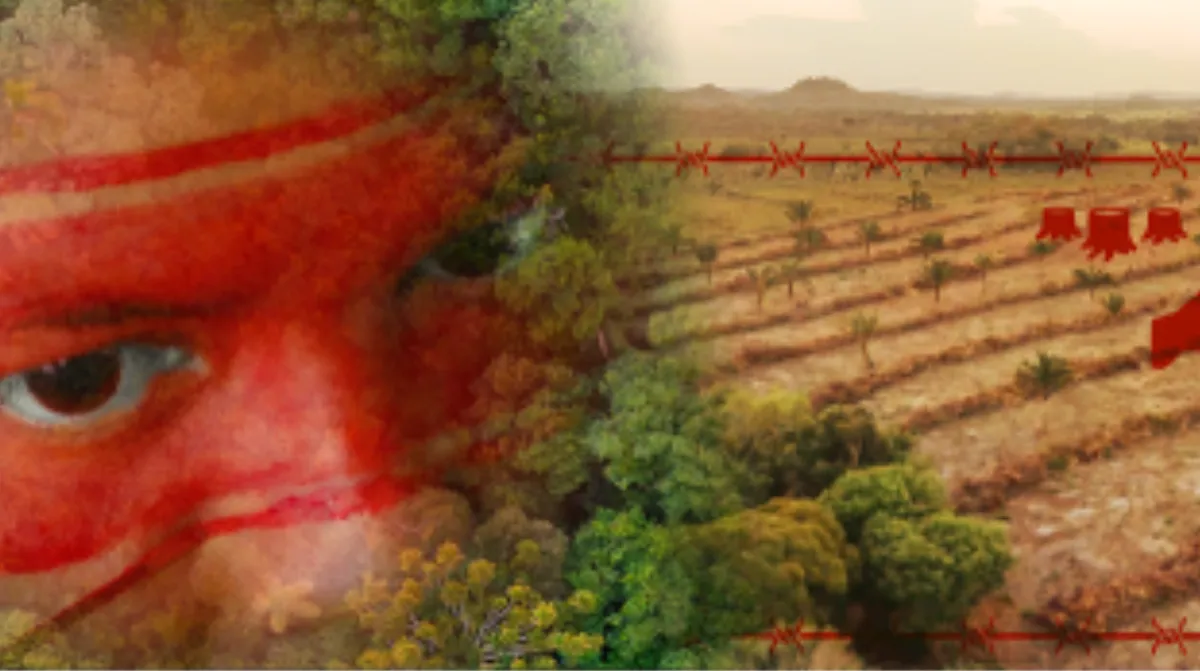
Groundbreaking reporting on illegal cattle ranching on Indigenous land in the Amazon rainforest by Rio-based Mongabay Reporter Karla Mendes has won the 2025 John B. Oakes Award for Distinguished Environmental Journalism.
The stories, featured in Mongabay’s investigative series “Blood Timber”, revealed a pattern of murders of Indigenous Guajajara people amidst a boom of cattle ranching and unlawful logging in and around Arariboia Territory in the Amazon rainforest. Brazil is the world’s largest exporter of beef, and the Amazon is home to approximately 43% of the country’s cattle herds. Mendes’ investigation led to justice for the community; after reviewing her reporting, officials removed thousands of cows grazing illegally in and around Arariboia Territory.
Mendes traveled to the region in 2023 and witnessed illicit cattle ranching and other environmental crimes both inside and outside the Arariboia Indigenous Territory. She also analyzed satellite images of the area and carried out a spatial analysis which proved that, among other crimes, deforestation had occurred in protected areas. Mendes then built several databases detailing the unlawful activities, collecting coordinates from the field, images and locations of incidents shared by the Guajajara community’s Forest Guardians. Forest Guardians are a group of Indigenous Guajajara who actively protect their ancestral homeland in the Amazon rainforest.
The Federal Public Prosecutor's Office and Brazil's federal environmental agency (IBAMA) both said the investigation's findings were unprecedented, and that they will be critical in their efforts to stamp out illegal cattle operations in the Arariboia Territory. The Forest Guardians also used the investigation in their request to the Inter-American Commission on Human Rights to protect their territory.
The Two Finalists for the 2025 Oakes Award are:
- “Toxic Gaslighting: How 3M Executives Convinced a Scientist the Forever Chemicals She Found in Human Blood Were Safe”, by Sharon Lerner, ProPublica and The New Yorker.
- “The unregulated link in a toxic supply chain,” by Naveena Sadasivam & Lylla Younes, Grist: Joaquín A. Rosado Lebrón, el Centro de Periodismo Investigativo: Andy Pierrotti, Atlanta News First: El Paso Matters.
More about the 2025 Oakes Finalists:
- Sharon Lerner’s “Toxic Gaslighting,” co-published with ProPublica and The New Yorker, is a master class in storytelling. Her investigation into the forever chemical PFOS – which was made by 3M and found in the blood of people around the world – produced a revealing and shocking exposé. As early as the 1970s, internal documents detailed how the forever chemicals had found their way into the blood of the general public. Then in 2023, Kris Hansen, a scientist with 3M who had never before spoken to a reporter, opened up to Lerner about what she had witnessed. The reporter then found other company insiders and a maze of documents that disclosed the extent of the company’s cover up. One lawyer suing 3M described the results as the “Rosetta Stone of PFOS … evidence that ties everything together and makes it irrefutable.”
- Grist's series of stories on the danger of ethylene oxide to people working in warehouses and medical sterilizing facilities is unique in its scope, its potential for impact on a varied group of affected communities, and its focus on collaboration with local journalists. The Grist team collaborated with the Centro de Periodismo Investigativo to describe impacts in Salinas, Puerto Rico, and with Atlanta News First to tell the story of affected workers in Lithia Springs, Georgia. Grist also partnered with El Paso Matters to reveal that warehouses across the United States, from El Paso, Texas to Richmond, Virginia, are leaking ethylene oxide just by storing packaged medical equipment. The judges commend Grist, the Centro de Periodismo Investigativo, El Paso Matters, and Atlanta News First for this series.
The 2025 John B. Oakes Award winner and finalists will be honored at Columbia Journalism School in September 2025. The winner will receive $5000 in prize money, and the two finalists will each receive $1500.
Given annually for news reporting that makes an exceptional contribution to the public’s understanding of environmental issues, the Oakes Award was founded in 1993 by family, friends and colleagues of John B. Oakes (1913-2001). Oakes was an environmental journalism pioneer and an editorial writer for The New York Times.
2025 John B. Oakes Prize Citations:
WINNER: Mongabay for “Investigation reveals the deadly nature of illegal cattle ranching on Indigenous territory in northeastern Brazil”
Journalist: Reporter Karla Mendes
Judges’ Citation:

An escalation in violence against the Guajajara people in the Arariboia Indigenous Territory of Brazil led reporter Karla Mendes to a life-threatening investigation into how illegal cattle ranchers and loggers invaded Indigenous land, often with deadly force, starting a series of environmental crimes, property theft, illegal development and other illicit activities in protected areas of the state of Maranhão. With the support of a fellowship from the Pulitzer Center’s Rainforest Investigations Network and Mongabay, Mendes revealed the direct connection between the expansion of the cattle industry and the increasing crimes against people and nature. Mendes’s reporting is an extraordinary achievement of documentation, multimedia and data reporting, mapping, and analyses.
Mendes risked her life multiple times to report from the ground, moving through areas dominated by the cattle ranchers to reach the Arariboia people in one of the most dangerous areas in the world. In a rare feat, Mendes both survived and brought back rigorously collected evidence that spurred a groundbreaking series of actions by local prosecutors, government regulators, and local and global organizations to stop the deforestation and systematic killing of Indigenous people.
FINALIST: ProPublica and The New Yorker
Journalist: Sharon Lerner
Judges’ Citation:
Sharon Lerner’s “Toxic Gaslighting” is a master class in storytelling. Her investigation into the forever chemical PFOS -- which was made by 3M and found in the blood of people around the world – produced a revealing and shocking exposé. But that’s only the beginning. She brilliantly framed the story as a mystery, asking how a company could keep such information secret. 3M already knew its complicity.

As early as the 1970s, internal documents detailed how the forever chemicals had found their way into the general public’s blood. Then in 2023, Kris Hansen, a scientist with 3M who had never before spoken to a reporter, opened up to Lerner about what she had witnessed. The reporter then found other company insiders and a maze of documents that disclosed the extent of the company’s cover up. One lawyer suing 3M described the results as the “Rosetta Stone of PFOS … evidence that ties everything together and makes it irrefutable.”
FINALIST: “The unregulated link in a toxic supply chain,” Grist, Centro de Periodismo Investigativo, El Paso Matters and Atlanta News First
Journalists: Naveena Sadasivam, Lylla Younes, Joaquín A. Rosado Lebrón, and Andy Pierrotti
Judges’ Citation:
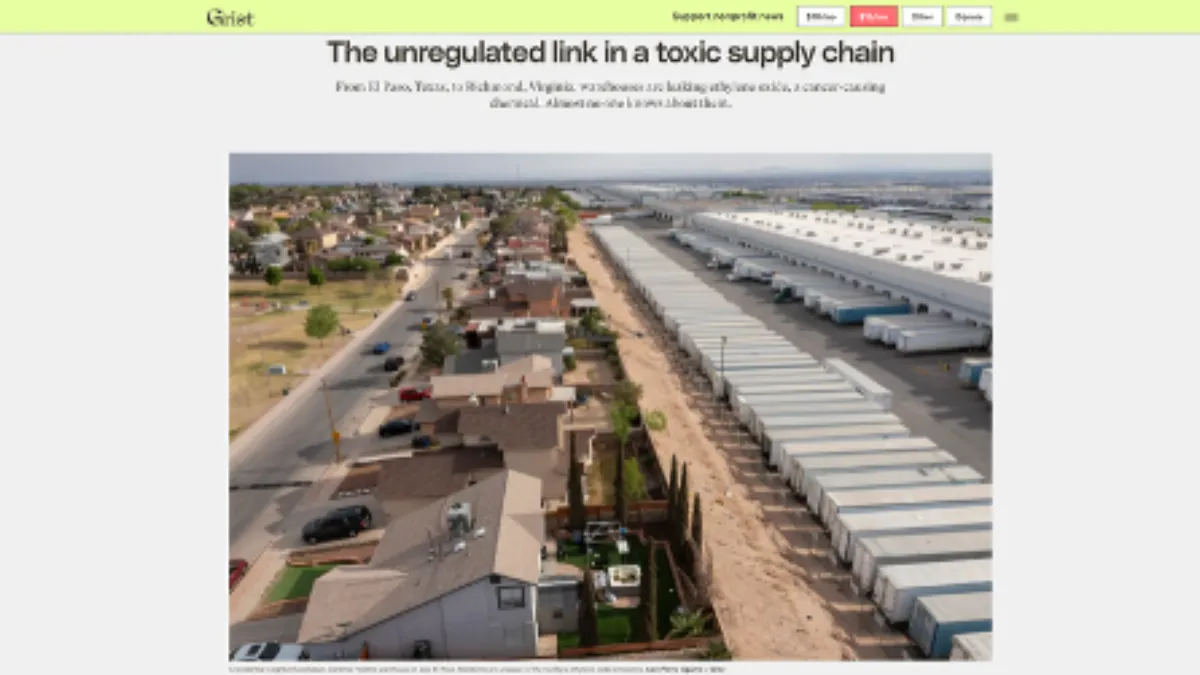
Grist's series of stories on the danger of ethylene oxide to people working in warehouses and medical sterilizing facilities is unique in its scope, its potential for impact on a varied group of affected communities, and its focus on collaboration with local journalists. The Grist team collaborated with the Centro de Periodismo Investigativo to describe impacts in Salinas, Puerto Rico, and with Atlanta News First to tell the story of affected workers in Lithia Springs, Georgia. Grist also partnered with El Paso Matters to reveal that warehouses across the United States, from El Paso, Texas to Richmond, Virginia, are leaking ethylene oxide just by storing packaged medical equipment.
Grist went further, publishing a detailed informational guide for people who have been exposed to this dangerous chemical, including recommended strategies to get local officials to address the problem. This guide, and some stories in the series, were published in both Spanish and English. The judges were particularly impressed by Grist's guide for fellow journalists, in which they encouraged others to investigate this story in their own community, and provided steps to access relevant datasets. The judges commend Grist, Centro de Periodismo Investigativo, El Paso Matters, and Atlanta News First for this series.
John B. Oakes Award Jury
The 2025 John B. Oakes Award Jury: Emilia Askari, an environmental journalist and educator; chair; Talia Buford, assistant managing editor for ProPublica; Jeff Burnside, independent journalist who has spent more than 20 years working as an investigative reporter; Laura Kurtzberg, assistant professor at Florida International University, a data analyst with the Pulitzer Center and the data visualization lead for Ambiental Media; Bernardo Motta, associate professor of journalism at Roger Williams University, educator and researcher; Anna Oakes, independent journalist and audio producer, and granddaughter of John B. Oakes; Susanne Rust, environmental reporter with the Los Angeles Times; Mark Trahant, founding editor of Indian Country Today and a member of the American Academy of Arts and Sciences; Kenneth R. Weiss, Pulitzer Prize-winning reporter who writes about science, environment and public health; Justin Worland, Washington D.C.-based senior correspondent at TIME covering climate change and the intersection of policy, politics and society.
About Columbia Journalism School
For more than a century, the school has been preparing journalists in programs that stress academic rigor, ethics, journalistic inquiry and professional practice. Founded with a gift from Joseph Pulitzer, the school opened its doors in 1912 and offers a Master of Science, Master of Arts, a joint Master of Science degree in Computer Science and Journalism and Doctor of Philosophy in Communications. It houses the Columbia Journalism Review, the Brown Institute for Media Innovation and the Tow Center for Digital Journalism. The school also administers many of the leading journalism awards, including the Alfred I. duPont-Columbia University Awards, the Maria Moors Cabot Prizes, the John Chancellor Award, the John B. Oakes Award for Distinguished Environmental Journalism, Paul Tobenkin Memorial Award and the Meyer “Mike” Berger Award.
Contact:
Abi Wright
Executive Director, Professional Prizes
212.854.5047
[email protected]