2025 Maria Moors Cabot Prize Winners Announced
Honoring Outstanding Reporting in Latin America and the Caribbean.
Special Citation for Investigation of the Catholic Church in Peru
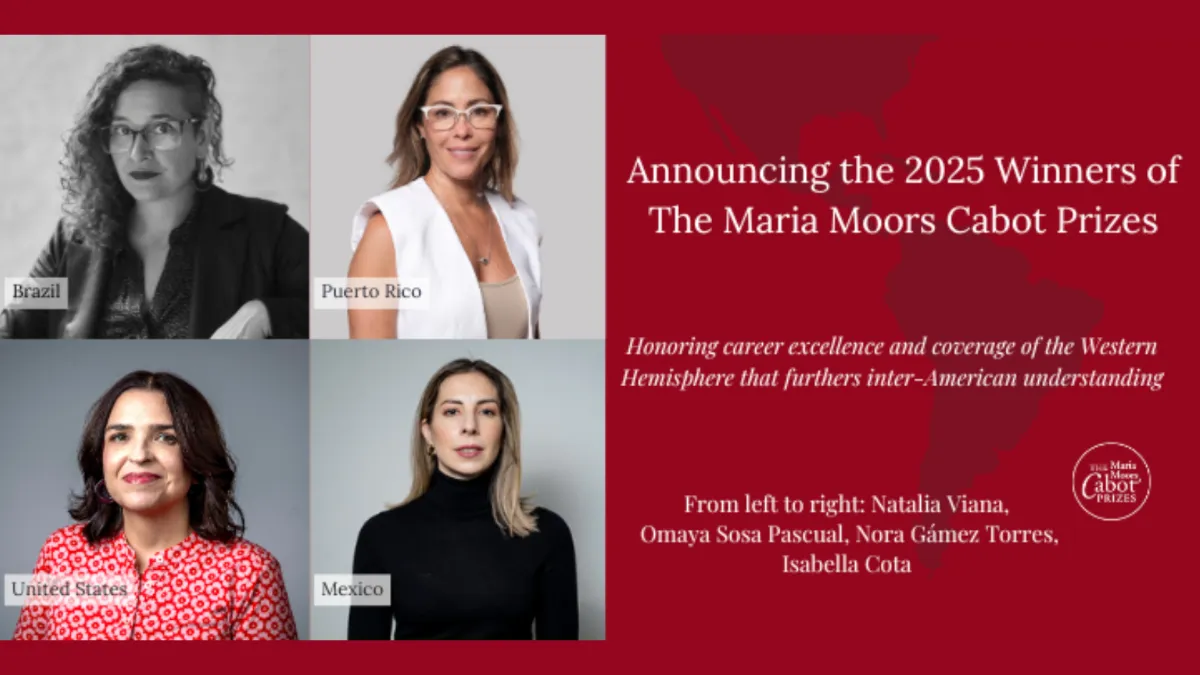
Columbia Journalism School announced the 2025 winners of the Maria Moors Cabot Prizes for outstanding reporting on the Americas. The 2025 Cabot Prize Gold Medalists are Nora Gámez Torres, Miami Herald and El Nuevo Herald, United States; Omaya Sosa Pascual, Center for Investigative Journalism (CPI), Puerto Rico; Isabella Cota, International Consortium of Investigative Journalists (ICIJ), Mexico; and Natalia Viana, Agência Pública, Brazil.
For the second time in its 86-year history, all four of the 2025 Cabot Prize Gold Medalists are women.
In addition, the Cabot Jury selected two 2025 Special Citation recipients; Paola Margot Ugaz Cruz, an investigative journalist from Peru whose courageous reporting prompted Pope Francis to dissolve a powerful Peruvian religious movement known as Sodalicio; and Jaime Abello Banfi, the co-founder of the Gabo Foundation in Colombia who has emphasized ethics and excellence in reporting, and has been a staunch defender of press freedom for journalists in Latin America.
The Cabot Prizes honor journalists and news organizations for career excellence and coverage of the Western Hemisphere that furthers inter-American understanding. Godfrey Lowell Cabot of Boston founded the Maria Moors Cabot Prizes as a memorial to his wife in 1938. They are the oldest international journalism awards.
Each Cabot Prize winner will receive a gold medal and a $5,000 honorarium. The 2025 Cabot Prize winners and Special Citation recipients will be celebrated at Columbia University on Weds., October 8.
“At this challenging time for the news media in the Americas, the Cabot Jury has selected a truly outstanding and courageous group of journalism innovators to honor with gold medals and special citations,” said Cabot Jury Chair Rosental Alves.
2025 Maria Moors Cabot Prizes Winners:
Nora Gámez Torres, Miami Herald and El Nuevo Herald, United States
For more than a decade, Miami Herald and El Nuevo Herald correspondent Nora Gámez Torres has provided deeply reported, compelling coverage of Cuba, becoming the most authoritative voice on the island nation in the U.S. media. With Cuban media under tight government control, many Cubans also learn about events in their own country through her reporting.
Before joining El Nuevo Herald in 2014, she taught journalism in Havana, and earned a PhD in Sociology from City University of London. Since the Obama administration, she has provided essential coverage of U.S.-Cuba relations and historic developments on the island, often beating Havana-based competition although she has not been allowed in Cuba for nine years.
Even from afar, Gámez Torres has documented daily life across the island in a collapsing economy. She has reported on the pivotal role Cuban Americans in Miami played in the return of capitalist enterprises to Cuba, written exclusives on the Havana Syndrome illness that struck U.S. diplomats and the arrest of a former U.S. ambassador in Miami who said he would plead guilty to acting as a foreign agent of Cuba.
Gámez Torres keeps both governments in her sights; she reported on a Cuban woman who was detained while doing a routine ICE check-in and then deported, leaving a still breastfeeding daughter and American husband behind.
For her fair, accurate and groundbreaking journalism, the Maria Moors Cabot Jury is proud to honor Nora Gámez Torres with a Cabot Gold Medal.
Omaya Sosa Pascual, Center for Investigative Journalism (CPI), Puerto Rico
For almost three decades, Omaya Sosa Pascual has forged a distinguished journalistic career in Puerto Rico and abroad, becoming one of the Caribbean's foremost reporters and editors, full of energy, ideas and resolution.
In 2007, she co-founded the Center for Investigative Journalism (CPI), the region's first nonprofit investigative journalism center. Under her leadership, the CPI became a leading force, revealing government corruption, the true death toll from Hurricane Maria in 2017, electoral irregularities, and many other highly sensitive issues. The work increased the visibility and importance of the center and allowed her to embark on an ambitious plan to fund, connect and support regional journalists. She also became a resource for journalists in need of training and guidance, both in Puerto Rico and abroad.
Investigating power in the Caribbean with few resources and often alone is a daunting task for journalists, especially on small islands where job opportunities are scarce. Sosa Pascual’s commitment under these circumstances has made her a role model and mentor for many.
In 2015, she co-founded Centro de Periodismo Investigativo’s Journalism Training Institute, which developed curriculum and held workshops for journalists from the Caribbean and Latin America, and has successfully guided and edited local and regional investigations. Sosa Pascual is also a strong and consistent advocate, writer, and speaker for investigative reporting.
For her outstanding contribution to inter-American understanding through her exemplary journalistic leadership, the Maria Moors Cabot Prize Jury is proud to honor Omaya Sosa Pascual with the Maria Moors Cabot Gold Medal.
Isabella Cota, International Consortium of Investigative Journalists (ICIJ), Mexico
Isabella Cota has dedicated her career to covering the economy and business in Latin America for a range of publications including El País, Reuters and Bloomberg. Her hard-hitting investigative reporting often focuses on political corruption and financial crimes. In her native Mexico she has exposed the cost that organized crime groups exact on businesses large and small, affecting everything from transportation to tortillas. In Costa Rica she broke news about how the international drug trade infiltrated the country’s prized national parks. And she followed the dark money used by Christian conspiracy groups to spread disinformation and run false abortion clinics in Latin America.
Her investigative reporting spans multiple countries to show how corruption works. She spent years looking into previously unknown ties between Mexican government officials and executives at an obscure U.S. startup that was granted billions of dollars worth of natural gas contracts. Isabella has a keen eye for the everyday people affected by economic policies and security failures.
Her insightful business and finance reporting that seeks government accountability is especially valuable amid dramatic changes in economic policies that are reshaping the Americas.
Isabella’s unique approach to journalism also incorporates gender and inequality even when catering to a business-savvy audience. She is a mentor to female journalists and an inspiration to many.
For her outstanding journalistic work and contribution to Inter-American understanding, the Maria Moors Cabot Jury is proud to honor Isabella Cota with a Cabot Gold Medal.
Natalia Viana, Agência Pública, Brazil
Natalia Viana is the kind of journalist our times demand: a reporter, editor, storyteller, and mentor to new generations. Above all, she is an entrepreneur who has built digital-native investigative media outlets to expose power and its inner workings in an era overwhelmed by disinformation.
Her investigations are rigorous and have had a profound impact. In one of them, she exposed illegalities in the landmark corruption taskforce Operation Carwash, later suspended by the Brazilian Supreme Court for being biased. Another investigation exposed how military justice is lenient when members of the military kill Brazilian civilians, leading to more oversight of the military courts.
Viana masters the formats and languages of the present: she takes her stories from the page to the podcast, expanding both their reach and their ability to raise awareness.
But her contribution goes beyond individual work. In 2011, along with Marina Amaral, she co-founded Agência Pública, a nonprofit independent media outlet.
Her vision of journalism as a network led her to build Agência Pública as a hub connecting hundreds of media organizations in and outside Brazil. Since then, she has led investigations into mass bee deaths caused by pesticides, forced evictions, surveillance and international fake news factories operating in Brazil under the protection of powerful interests. She also founded Truco, one of Brazil’s first fact-checking initiatives.
For her leadership, innovation, and an uncompromising journalistic ethic, the jury is proud to honor Natalia Viana with the Cabot Gold Medal.
2025 Maria Moors Cabot Prize Special Citations
Paola Margot Ugaz Cruz, Investigative Journalist, Peru
In one of the final edicts he issued before his death, Pope Francis abolished a powerful Peruvian religious movement known as the spiritual family of Sodalicio de Vida Cristiana. This group was held responsible by the Vatican for systematic and atrocious abuse of its followers, both spiritual and sexual, some of whom were minors.
What led Francis to take this unprecedented step was journalism by the courageous Paola Margot Ugaz Cruz. In 2015 she and Pedro Salinas Chacaltana, a former member of Sodalicio, co-wrote a book titled, Half Monks, Half Soldiers, which detailed dozens of detailed and horrifying accounts of Sodalicio clergy subjecting their youngest, most vulnerable followers to physical, psychological and sexual assault, verging on torture. Her work showed how Sodalicio mismanaged the church’s money and properties for its own enrichment, and how the movement’s ties to the country’s most influential elected officials and business magnates allowed it to operate with impunity.
Since Paola Ugaz brought these facts to light, she has suffered intimidation and lawsuits. However, these attacks only served to energize the journalist. As she heard from her mentor Gustavo Gorriti: “Fear can never be your editor.”
Yes, journalism can play an important role in advancing democracy and freedom, but only when in the hands of journalists with the bravery to use it for that purpose. Because Ugaz epitomizes such journalists, at a time when they are sorely needed, she has earned a special citation from the Maria Moors Cabot Jury.
Jaime Abello Banfi, Gabo Foundation, Colombia
Thirty years ago, Jaime Abello Banfi co-founded the Foundation for New Ibero-American Journalism alongside Gabriel García Márquez—later renamed the Gabo Foundation in honor of the Nobel laureate’s widely recognized nickname. García Márquez, who always saw himself “first and foremost as a journalist,” envisioned the foundation as a way to give back to “the most beautiful profession in the world.”
Recruited by García Márquez from a television station in Barranquilla, Colombia, Abello Banfi transformed that vision into reality, developing an institution that has benefited thousands of journalists across Latin America. Through workshops, conferences, awards, publications, and other initiatives, the foundation has emphasized ethics, excellence in reporting and writing, and innovative storytelling for the digital era. A staunch defender of press freedom, Abello Banfi has also been a steadfast supporter of Latin American journalists under attack.
In recognition of his extraordinary contributions to journalism in Latin America and his role in advancing Inter-American understanding, the Maria Moors Cabot Jury honors Jaime Abello Banfi with a Special Citation.
Members of the Cabot Prize Board in 2025:
Jury Chair Rosental Alves, Knight Chair in International Journalism, University of Texas, Austin; Hugo Alconada Mon, investigative journalist, La Nación (Argentina); Juan Enríquez Cabot, chairman and CEO of Biotechonomy, LLC; Carlos Fernando Chamorro, founder and editor, Confidencial (Nicaragua); Angela Kocherga, KTEP news director who also reports in the field on border issues including migration, the border security buildup, binational health, and trade; Marjorie Miller, administrator, Pulitzer Prizes, Columbia University; Elena Cabral, assistant dean, academic and international programs at Columbia Journalism School; Boris Muñoz, Venezuelan-American journalist, author and editor; Ginger Thompson, managing editor, ProPublica; Adriana Zehbrauskas, documentary photographer based in Phoenix, Arizona; Abi Wright, executive director of Professional Prizes at Columbia Journalism School.