A Dialogue on Standing Up for Public Health and Democracy
Dean Jelani Cobb and Richard Besser discuss public health, democracy and the future.
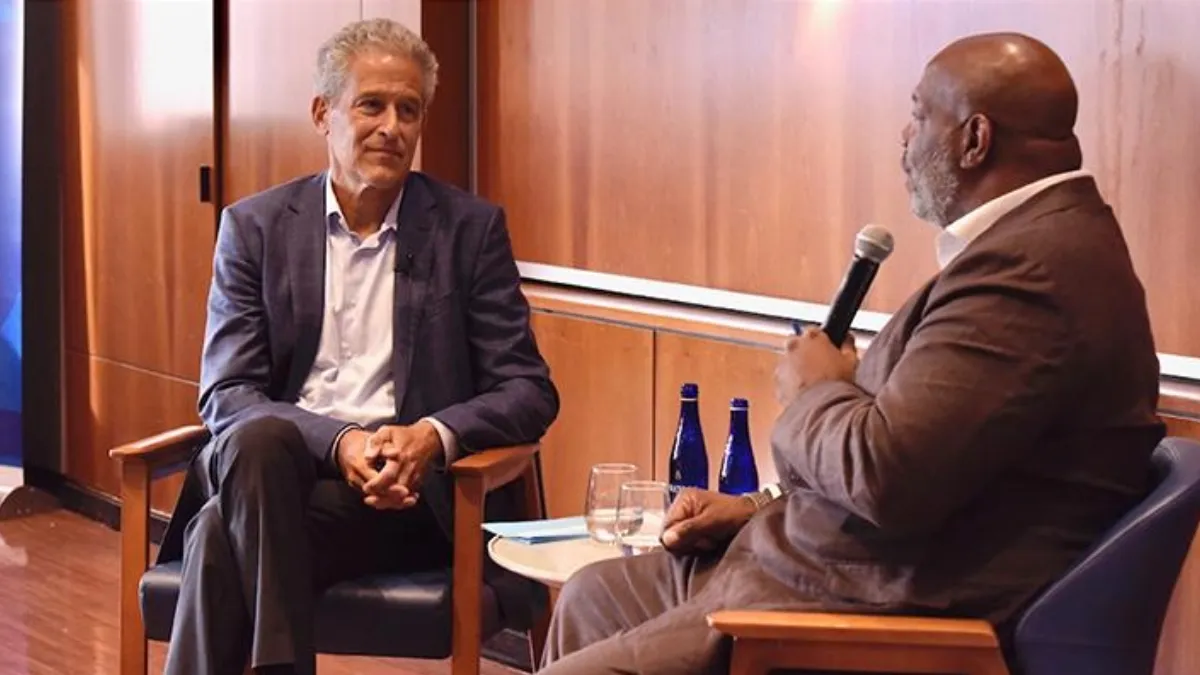
What’s happening, and how did we get here? A public conversation between two leaders in public health philanthropy and academia traced the historical origins of recent attacks on public health and democracy and shared their ideas on how to defend them for the future.
Richard Besser, president and CEO of the Robert Wood Johnson Foundation(link is external and opens in a new window) (RWJF), and Jelani Cobb, dean of the Columbia Journalism School, were the featured speakers of the 2025 Isidore I. Benrubi Lecture in the History and Ethics of Public Health at the Columbia Mailman School. Established in 2007, the annual lecture series addresses topics in history, science, policy, and ethics. Besser and Dean Cobb were introduced by Interim Dean Kathleen Sikkema and Merlin Chowkwanyun, co-director of the School’s Center for History and Ethics of Public Health.
Journalism is a common thread for Besser and Dean Cobb. Dean Cobb is a longtime contributor to the New Yorker magazine, where he writes on race, politics, history, and culture. Besser, a pediatrician by training, was chief health and medical editor at ABC News from 2009 to 2017. Previously, he worked at the Centers for Disease Control and Prevention (CDC); among other accomplishments, he led the agency’s response to the H1N1 influenza (swine flu) pandemic.
The conversation looked to history to explain the current political moment, including recent attacks on the independence of the CDC. It wasn’t long ago that public health enjoyed strong support across the political spectrum, Besser observed. While earlier criticism of public health priorities like water fluoridation was confined to the fringe, “the [recent] wholesale assault on the world’s best public health agency is unprecedented,” he said. To explain the shift, he pointed to the COVID pandemic. Public health became politicized as some Americans felt their liberties were being infringed by social distancing, masking, and vaccines. Public health leaders in the U.S. were laser-focused on policies to reduce the risk of mortality. Yet they often minimized the costs— “not factoring in the risk of isolation, the risk to the economy,” Besser explained.
During the 2009 H1N1 pandemic, Besser prioritized transparent communications; his team continually reminded the public that recommendations can change as new information comes in. “We wanted people to know what we knew when we knew it [and] what we didn’t know,” he recalled. Communications style is another consideration, Dean Cobb noted. “The people who are peddling quack cures know how to talk in a way that the establishment frequently does not.”
The irony of the MAHA movement is that its proponents already care deeply about health, Dean Cobb observed. “We have a public that is concerned about the poor quality of its own and somehow that concern has been siphoned off into every kind of quack cure you can imagine, every kind of conspiratorial idea about medical practice, about public health practice,” he said.
Of course, the problem wasn’t just a gap in communications. The high cost of health care and higher education may have fueled some of the anger seen in the 2024 election. “We have to be willing to look into our own backyards,” Dean Cobb said. “Tell me why [the public] should trust us. We have to be able to answer that question individually and collectively before we can start to make any kind of progress.”
Read more at Columbia University Mailman School of Public Health.